Music can lift a video more than almost anything else, but it is also one of the most common reasons videos are muted, blocked or removed. Buying a song or streaming it does not give you the right to put it in your video. Using music in video needs permission from the people who own it, and a single song often has more than one owner. This lesson explains the rights inside a piece of music, the main types of licence, royalty-free and library music, how platforms detect music, and how to keep your projects safe.
Why music needs a licence
Music is protected by copyright, just like photographs, as explained in understanding copyright in photography. A licence is permission to use a work in a specific way, as explained in licensing and usage rights. Owning a copy of a song, for example a download, only lets you listen to it. Putting it in a video is a different use that needs its own permission.
Warning:This lesson gives general information. Music rights and laws differ between countries and change over time. For important commercial projects, check licences carefully or ask a specialist.
Two copyrights in one song
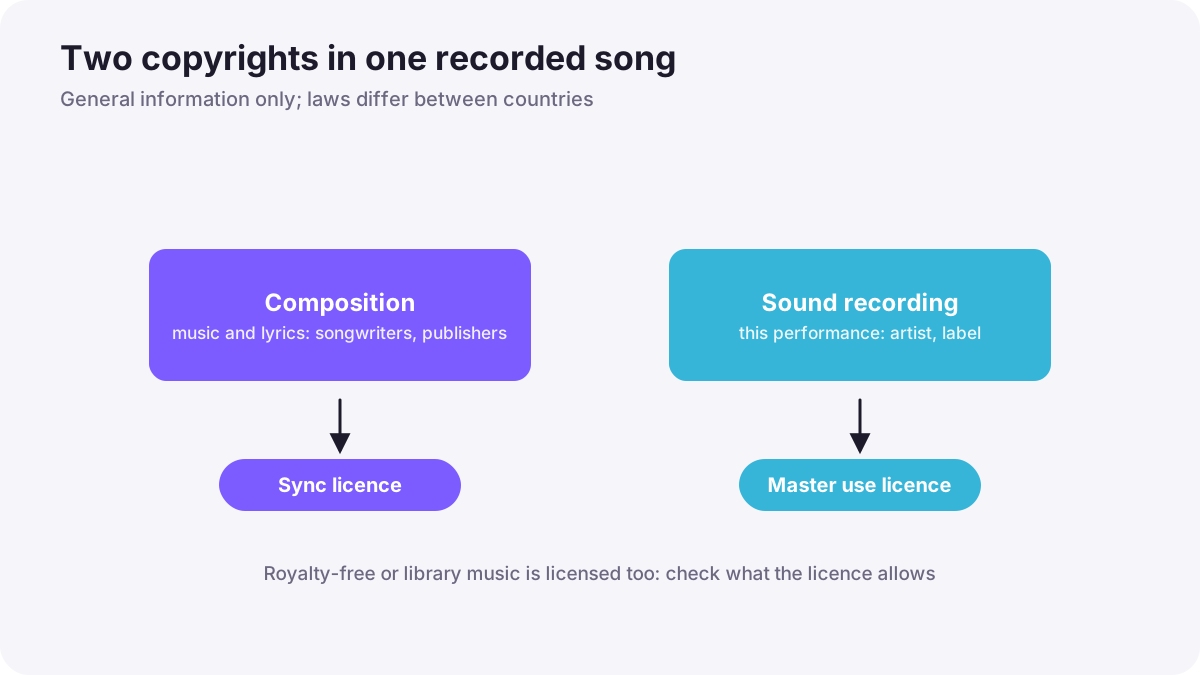
| Right | What it covers | Usually owned by |
|---|---|---|
| Composition | The written music and lyrics | The songwriters and their music publishers |
| Sound recording (master) | One particular recorded performance | The artist or record label |
To use an existing recorded song in a video, you usually need permission for both: a synchronization (sync) licence for the composition and a master use licence for the recording.
Main types of music licence
| Option | What it means | Typical use |
|---|---|---|
| Sync and master licences | Permission negotiated with publishers and labels | Films, adverts, famous songs |
| Production or library music | Music made for video, licensed by a library | Corporate, documentary, online video |
| Royalty-free licence | Pay once or subscribe, then use under the licence terms without per-use royalties | Most creator projects |
| Creative Commons music | Free to use under specific conditions, such as credit | Small projects, as in licensing and usage rights |
| Commissioned music | A composer writes original music for you | Brand films, films, unique projects |
Warning:Royalty-free does not mean free, and it does not mean any use is allowed. Every licence has terms: which projects, which platforms, whether advertising or broadcast is included, and for how long. Read them before you choose a track.
How platforms detect music
Large video platforms automatically compare uploaded videos with databases of copyrighted music. When they find a match, the owner may block the video, mute the audio, or take any advertising income. Some licensed library tracks are also registered in these systems, so keep your licence ready to prove permission if a claim appears. Platforms also offer their own music libraries that are licensed for use on that platform.
Common misunderstandings
- Using only a few seconds: there is no general rule that short clips are free to use.
- Giving credit: naming the artist is not the same as permission.
- Non-commercial use: personal or unpaid videos still need permission.
- Fair use or fair dealing: limited exceptions exist in some countries, but rarely cover background music, as in understanding copyright in photography.
- Old music: a composition may be in the public domain, but a modern recording of it is usually still protected.
A safe music routine
- Decide where the video will appear and whether it is commercial, advertising or broadcast.
- Choose music from a source whose licence covers that use.
- Download and save the licence or certificate with the project.
- Credit the music if the licence requires it.
- Tell clients about music restrictions in your quote, as in pricing video services.
Common mistakes
- Using popular songs without permission: videos are muted, blocked or removed.
- Choosing a licence that excludes advertising: a client's ad uses music illegally.
- Not keeping licence records: you cannot prove permission when a claim appears.
- Assuming client-supplied music is cleared: ask who holds the rights.
- Licensing only the composition: the recording owner can still claim the video.
How productions clear music
Professional productions plan music early, budget for licences or composers, and keep written clearance for every track. Larger productions use music supervisors who negotiate sync and master licences. Creators and small studios usually rely on reputable libraries or subscriptions, check that each licence covers the client's use, and store licences with the project archive.
Practical examples
A wedding film with a popular song
- Situation
- A couple wants their favourite chart song in their highlight film shared online.
- What to do
- You explain that the song needs sync and master permission, and offer a licensed library track in a similar mood.
- Why it works
- Licensed music avoids blocking and legal problems.
- Result
- A film the couple can share freely.
A claim on a client video
- Situation
- A platform flags music in a company video, even though you licensed it.
- What to do
- You send the platform the licence certificate saved with the project.
- Why it works
- Records prove your permission.
- Result
- The claim is released.
Key points
- Owning or streaming a song does not give the right to use it in a video.
- A recorded song has two copyrights: the composition and the sound recording.
- Using an existing song usually needs a sync licence and a master use licence.
- Royalty-free and library music are licensed, not free; always check the terms.
- Keep licence records, credit when required, and check that licences cover the client's use.
Frequently asked questions
Can I use any song in my video if I give credit?
What is a sync licence?
Is royalty-free music free?
Can I use 10 seconds of a song?
Conclusion
Music in video needs permission for both the composition and the recording, or a library licence that covers your exact use. Choose carefully, keep records and explain music options to clients. Next, you will learn the permissions needed to film people and places.
Finished reading? Track your progress through Copyright, ethics and safety.