Many photographers who start offering video are surprised by how much time it takes. A one-day shoot can need several days of editing, plus planning, sound work, music licensing and client revisions. If video is priced like photography, the business quickly loses money. This lesson explains what goes into the cost of a video project, how to estimate each stage, how crew, equipment, music and usage affect the price, and how to present clear video quotes that clients understand.
Why video pricing is different
The basics of pricing, such as your cost of doing business and your creative fee, were explained in pricing photography services, and estimating in estimating costs, time and value. Video uses the same method, but each project has more stages, more people and more post-production time, so the estimate must cover all of them.
The stages of a video project
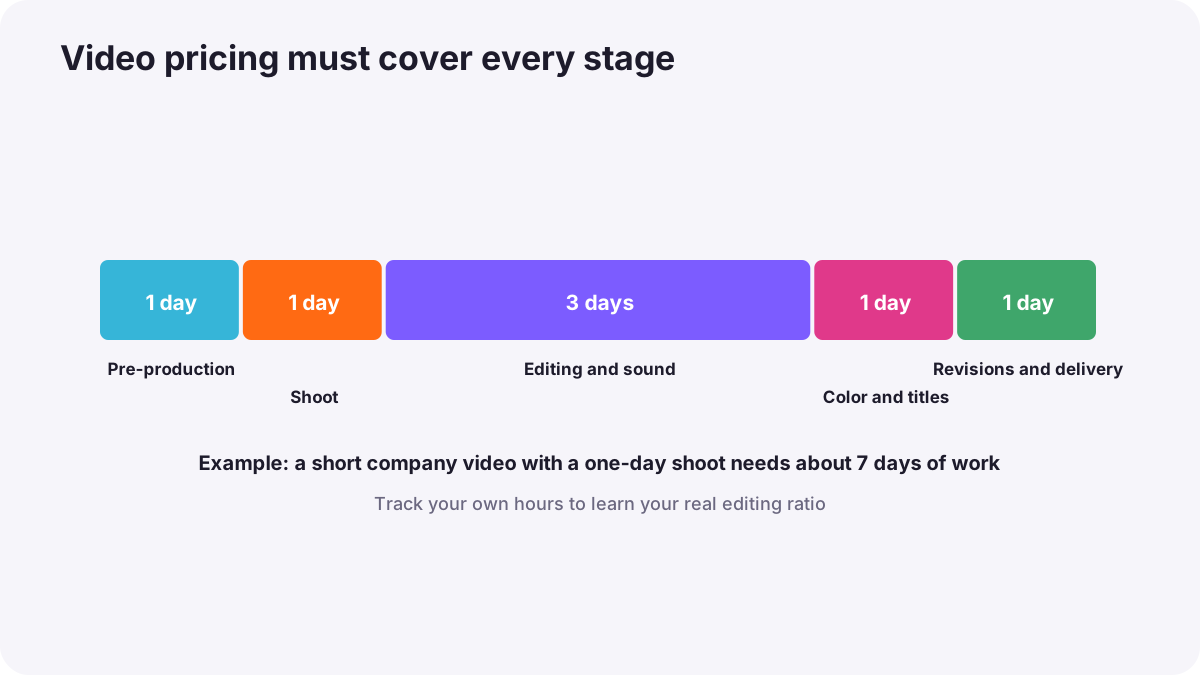
| Stage | Typical work |
|---|---|
| Pre-production | Meetings, concept, script or outline, storyboards, location scouting, scheduling |
| Production (shooting) | Shoot days, setup and packing, travel |
| Post-production | Offloading, organizing, editing, sound mixing, color grading, titles |
| Revisions | Changes after the client reviews the first version |
| Delivery | Exporting versions, captions, uploading, archiving |
Tip:As a rough starting point, many simple projects need one to three editing days for each shooting day, and story-driven or heavily graded films can need much more. Track your own hours on every project to learn your real ratio.
What the price must cover
- Your time: every stage, not just the shoot day.
- Crew: second shooters, sound recordists, editors or assistants, each with their own day rate.
- Equipment: cameras, lenses, lights, sound gear, stabilizers and storage, whether owned or rented.
- Storage: drives for footage and backups, as in offloading and backing up video footage.
- Music and stock footage: licences, as in music licensing for video.
- Travel and permits: transport, accommodation and location fees.
- Usage: how and where the client will use the video, as in licensing and usage rights.
- Contingency: a buffer for the unexpected, as in estimating costs, time and value.
A simple estimate
The numbers below are only an example. Use your own day rates and costs, which depend on your market and experience.
| Item | Quantity | Example cost |
|---|---|---|
| Pre-production | 1 day | 1 × your day rate |
| Shoot day with assistant | 1 day | 1 × your rate + 1 × assistant rate |
| Editing and sound | 3 days | 3 × your editing rate |
| Color grading and titles | 1 day | 1 × your rate |
| Two rounds of revisions | Included | Part of the editing time |
| Music licence | 1 track | Licence fee |
| Equipment and storage | Project | Your equipment charge |
| Contingency | 10 to 15% | Of the total |
Pricing models for video
- Project price: one total for the agreed deliverables; clients like the certainty.
- Day rates: for shooting or editing when the scope is unclear or the client manages the project.
- Packages: fixed options for repeat services, such as event films, as in hybrid photo and video packages.
- Retainers: a monthly amount for regular content, as in repeat business and long-term relationships.
Pricing models were introduced in pricing photography services.
Revisions and scope
Video revisions can take hours each, so the quote and contract should state how many revision rounds are included, what counts as a revision, and the price of extra changes. List every deliverable: lengths, formats, aspect ratios and captions. Revision policies were explained in client expectations and revisions, and quotes in proposals and quotations.
Common mistakes
- Pricing only the shoot day: editing and revisions are unpaid.
- Unlimited revisions: projects never end.
- Forgetting music and storage costs: profit disappears.
- Vague deliverables: the client expects five versions and you planned one.
- Ignoring usage: a video used in national advertising is priced like a private film.
How production companies price video
Video production companies build detailed budgets line by line: pre-production, crew, equipment, locations, post-production, music, delivery, usage and contingency. They define deliverables and revision rounds in writing, take a deposit before starting, and track actual hours afterward to improve future estimates.
Practical examples
An underpriced first video
- Situation
- You charged one photography day rate for a client video and spent five days in total.
- What to do
- For the next project, you estimate pre-production, shoot, editing, grading and revisions separately.
- Why it works
- Each stage takes real time that must be paid.
- Result
- A fair price that covers the full workload.
Endless changes
- Situation
- A client keeps asking for small edits after delivery.
- What to do
- Your next contract includes two revision rounds and a price for additional changes.
- Why it works
- Clear limits protect your time and set expectations.
- Result
- Faster approvals and paid extra work.
Key points
- Video pricing uses the same method as photography but covers more stages and time.
- Estimate pre-production, shooting, post-production, revisions and delivery separately.
- Include crew, equipment, storage, music, travel, usage and contingency.
- Track your real editing hours; many projects need several editing days per shoot day.
- State deliverables and revision rounds clearly in quotes and contracts.
Frequently asked questions
How much should I charge for video?
Why is video more expensive than photography?
How many revisions should I include?
Should I charge a day rate or a project price?
Conclusion
Price video by estimating every stage, from planning to delivery, and every cost, from crew to music and usage, with clear deliverables and revision limits. Next, you will learn how to combine photo and video into hybrid packages.
Finished reading? Track your progress through Photography business.