In a photo, focus has to be right for one moment. In video, it has to stay right for every frame while people and the camera move. A face that drifts out of focus for one second can spoil a whole shot. Video makers therefore use autofocus settings made for movement, and the professional skill of pulling focus by hand. This lesson explains how video autofocus works, how to set it up, how manual focus pulling and rack focus are done, and which tools make focus easier.
Why focus is harder in video
Focus means making your chosen subject sharp, as explained in understanding focus. In video, the subject, the camera or both may move during a shot, so focus must change smoothly and at the right time. The audience also sees every focus change, so a sudden jump or a slow search back and forth is very noticeable.
Shallow depth of field, which gives a soft background, makes focus even more critical, because the sharp zone is very thin. Depth of field was explained in focus distance, depth of field and subject separation.
Video autofocus
Modern cameras and phones have strong video autofocus that tracks faces, eyes, animals and vehicles, as introduced in autofocus systems, AF modes and subject detection. In video it works continuously, so it keeps adjusting while you record.
| Setting | What it does | Good starting choice |
|---|---|---|
| Continuous AF | Keeps adjusting focus during recording | On for moving subjects |
| Subject detection | Finds and follows faces, eyes, animals or vehicles | Matched to your subject |
| AF transition speed | How fast focus moves from one subject to another | Slower for a smooth, cinematic change |
| AF sensitivity or tracking | How quickly AF switches to a new subject | Lower to avoid jumping to people who walk past |
| Touch to focus | Tap the screen to choose the subject | Useful on phones and gimbals |
Remember:Names of these settings vary between brands. Look for focus speed and tracking sensitivity in your camera's video or movie autofocus menu.
Manual focus pulling
Pulling focus means turning the focus ring during a shot to keep a moving subject sharp, or to move focus from one subject to another. On film sets, this is the job of the focus puller, also called the first assistant camera, who works the focus while the camera operator frames the shot.
- Measure distances: know how far the subject will be at the start and end of the shot.
- Make focus marks: mark those distances on the lens, the focus ring or a follow focus.
- Rehearse: practise the move with the actor or subject before recording.
- Move smoothly: start and stop the focus change gently, not suddenly.
Manual focus aids such as focus peaking and magnification are explained in manual focus and focus assistance.
Rack focus
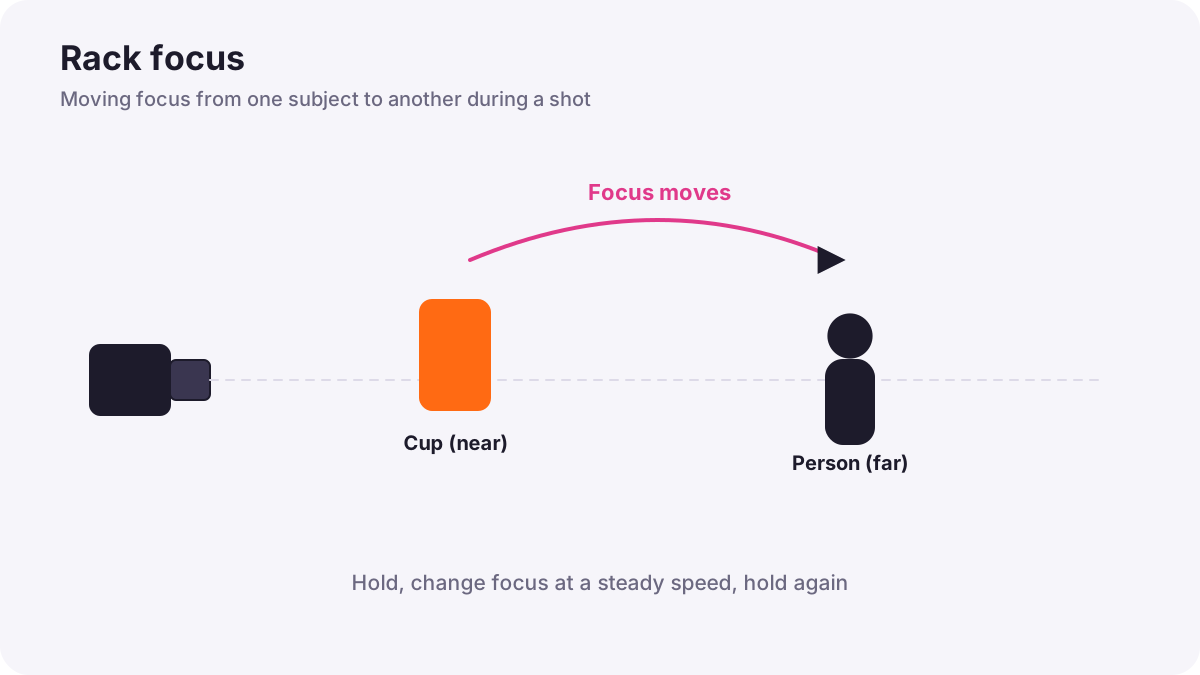
A rack focus is a deliberate change of focus from one subject to another during a shot, for example from a cup of coffee in the foreground to a person entering the room behind it. It guides the viewer's attention like a cut, but inside one shot. Rack focus works best with shallow depth of field, so the change is clearly visible.
Tip:Let the first subject be sharp for a moment, change focus at a steady speed, then hold the second subject sharp before cutting. Many cameras let you set two autofocus points and rack between them automatically.
Focus tools
| Tool | What it is | Why it helps |
|---|---|---|
| Follow focus | A geared wheel attached to the lens focus ring | Smooth, repeatable focus moves with marks |
| Wireless follow focus | A motor on the lens controlled by a handset | A focus puller can work away from the camera |
| External monitor | A bigger screen attached to the camera | Easier to judge sharpness |
| Focus peaking | Colored outlines on sharp edges | Shows what is in focus at a glance |
| Cine lenses | Lenses with long, smooth focus rings and distance marks | Precise manual focus, as in lenses for video |
Choosing autofocus or manual focus
- Use face or eye autofocus for vlogs, interviews, events and moving people, with a slower transition speed.
- Use manual focus for planned rack focus, product shots, low light and scenes where autofocus may jump to the wrong subject.
- Close the aperture a little when focus is difficult, to give yourself a deeper sharp zone.
- Check focus with magnification before you record important shots.
Common mistakes
- Very fast autofocus speed: focus snaps suddenly, which looks unnatural in video.
- Autofocus jumping to the background: set subject detection and lower tracking sensitivity.
- Very wide apertures for moving subjects: the sharp zone is too thin to follow.
- Pulling focus without rehearsing: the subject is soft at the important moment.
How professionals handle focus
On film sets, focus pullers measure distances, place marks, rehearse every move and use wireless follow focus systems so they can concentrate on sharpness. Solo creators rely on modern face and eye autofocus with carefully chosen speed and sensitivity, and switch to manual focus for planned shots. Both check focus on a larger screen before the important take.
Practical examples
A walking interview
- Situation
- A person walks toward the camera while talking.
- What to do
- You use continuous eye-detection autofocus with a medium-slow transition speed.
- Why it works
- Eye tracking follows the face smoothly as the distance changes.
- Result
- The face stays sharp from start to end without visible jumps.
A product reveal
- Situation
- You want focus to move from a coffee cup to a person behind it.
- What to do
- You set manual focus, mark both distances and rehearse a slow, even rack focus.
- Why it works
- A planned manual rack gives exact timing and a smooth move.
- Result
- A polished shot that guides the viewer from the product to the person.
Key points
- Video focus must stay correct across every frame, and viewers see every change.
- Use continuous autofocus with subject detection, a slower transition speed and lower sensitivity.
- Pulling focus means turning the focus ring during the shot; professionals measure, mark and rehearse.
- A rack focus moves attention from one subject to another within one shot.
- Follow focus, peaking, magnification, external monitors and cine lenses make focus easier.
Frequently asked questions
What is focus pulling?
What is a rack focus?
Should I use autofocus for video?
What is a follow focus?
Conclusion
Keeping video in focus means choosing smooth autofocus settings or pulling focus by hand with measured marks and rehearsal. Rack focus adds a storytelling tool inside one shot. Next, you will learn how to keep video shots steady with handheld technique, tripods, gimbals and sliders.
Finished reading? Track your progress through Focus and depth of field.