Many clients want both photos and video from the same event or project: a wedding with portraits and a highlight film, or a brand with product images and short social videos. Offering both together, called a hybrid service, can save the client time and earn you more, but it is harder than it looks. Photo and video need different settings, positions and attention, sometimes at the same moment. This lesson explains how to deliver hybrid work as one person or as a team, how to plan the day, and how to build and price clear hybrid packages.
What a hybrid service is
A hybrid service delivers both photographs and video for the same client and project. Hybrid creators were introduced in photography and videography, and specialist services in developing specialist services. The key question is not whether you can do both, but whether you can do both well at the same time.
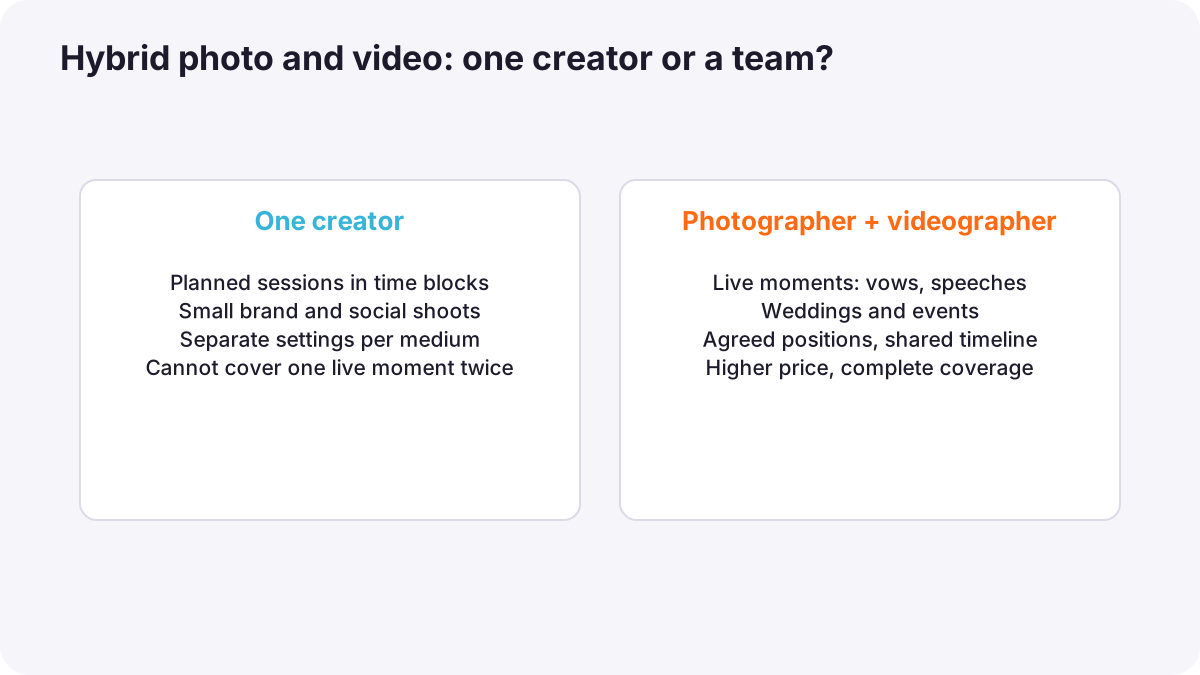
One creator or a team
| Approach | Works well for | Limits |
|---|---|---|
| One creator switching between photo and video | Small brand shoots, social content, planned sessions | You cannot do both during the same key moment |
| Two creators: one photo, one video | Weddings, events, live moments | Higher cost; needs coordination |
| A team led by one business | Larger events and productions | Requires management and consistent style |
Warning:For unrepeatable moments such as vows, speeches or a product launch, one person cannot give full attention to both photo and video. Use two people for those moments.
Why photo and video conflict
- Settings: video needs a shutter speed tied to frame rate, as in exposure for video; photos often need faster speeds.
- Light: flash helps photos but appears as a flash in video; continuous light suits both.
- Positions: the photographer moves for the best angle while the video camera needs a clean, steady view.
- Sound: camera shutter noise and talking can spoil recorded audio.
- Time: pausing video to take photos means missing moments in the film.
Planning a hybrid shoot
- List all deliverables for photo and video separately.
- Plan time blocks: for example, 20 minutes of portraits, then 15 minutes of video of the same scene.
- Decide who covers each key moment and from where.
- Use continuous light where both photo and video are needed at once.
- Use silent electronic shutter for photos during recorded speeches where possible.
- Use two camera bodies set up for photo and video so you do not change settings in a rush.
Tip:Many modern cameras let you store separate settings for photo and video and switch with one control, as in picture styles and camera customization.
Building hybrid packages
Tiered packages, as in proposals and quotations, work well for hybrid services:
| Package | Photo | Video | Team |
|---|---|---|---|
| Essential | Edited gallery of key moments | 1-minute highlight clip | One creator |
| Standard | Full edited gallery | 3 to 5-minute highlight film and teaser | Photographer and videographer |
| Premium | Full gallery and album | Highlight film, full ceremony or event edit, social clips | Full team |
Pricing hybrid work
Price each part properly, as in pricing video services, then decide whether to offer a small combined discount for the saved travel and planning. Do not simply add a small extra fee for video: the editing time alone can be larger than the whole photo job. Be clear in the contract about every deliverable and revision round, as in contracts and client communication.
Common mistakes
- Promising full photo and video coverage alone: key moments are missed in one or the other.
- Adding video for a small extra fee: editing time makes the job unprofitable.
- Changing settings in a rush: photos are blurred or video exposure jumps.
- Flash during recorded moments: the film shows bright flashes.
- No clear deliverables list: the client expects more than you planned.
How hybrid studios work
Successful hybrid studios use separate photographers and videographers for live events, share a planned timeline and positions, and keep a consistent visual style between photos and films. Solo hybrid creators focus on planned sessions with time blocks for each medium, use separate camera bodies or saved settings, and price photo and video on their real time.
Practical examples
A small brand shoot
- Situation
- A café wants product photos and three short social videos.
- What to do
- You plan 2 hours of photos, then 2 hours of video with continuous light, using one setup.
- Why it works
- Planned time blocks let one creator do both without conflict.
- Result
- High-quality photos and videos from one efficient day.
A wedding enquiry
- Situation
- A couple asks one creator for a full gallery and a full ceremony film.
- What to do
- You offer a standard package with a second creator for video.
- Why it works
- One person cannot cover the vows fully in both photo and video.
- Result
- Complete coverage of every key moment.
Key points
- Hybrid services deliver photos and video for the same client and project.
- One creator can do both in planned sessions; live key moments need two people.
- Photo and video conflict in settings, light, positions, sound and time.
- Plan time blocks, use continuous light, silent shutters and separate camera setups.
- Price each part on its real time and list every deliverable in the contract.
Frequently asked questions
Can one person shoot photo and video at a wedding?
How should I price photo and video together?
What is a hybrid shooter?
Do I need different cameras for photo and video?
Conclusion
Hybrid photo and video packages work when each medium gets the time, people and price it needs: planned blocks for solo work, a team for live moments, and clear deliverables. You have now completed the business course for both photography and video.
Finished reading? Track your progress through Photography business.