A photograph freezes one moment. A video shows moments flowing one after another, often with sound. Today the same camera, and even the same phone, can do both, and many clients ask for photos and video together. The good news is that almost everything you learn in photography, such as light, exposure, focus, lenses and composition, also makes you a better video creator. This lesson explains what video really is, how it differs from photography, and which skills carry across, so you can learn both at the same time.
What is videography?
Videography is the craft of recording moving images, usually with sound, to show events, tell stories or share information. A video is made of many still pictures, called frames, recorded one after another. When the frames are played back quickly, your brain sees smooth movement instead of separate pictures.
Cinematography is a closely related word. It usually means the art of designing the look of a film: how each shot is lit, framed and moved. In everyday use, people often say videography for events, social media and business videos, and cinematography for films and high-end productions. The skills are the same family.
Remember:Photography and video grew from the same experiments. In 1878 Eadweard Muybridge used a row of cameras to photograph a running horse, and when the photos were shown quickly one after another, the horse seemed to move. In 1895 the Lumière brothers showed short films to a paying audience in Paris, one of the first public film screenings. Moving pictures were born from still photographs.
How video creates movement
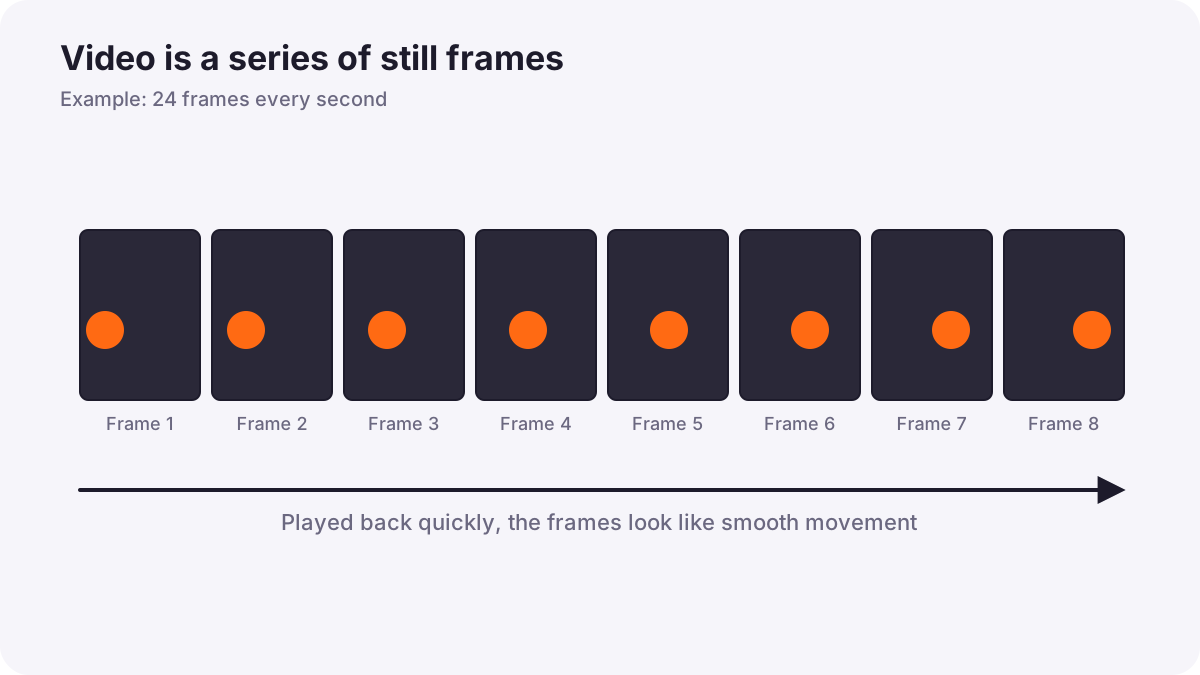
A video camera records a series of frames at a steady speed called the frame rate, measured in frames per second (fps). Common frame rates are 24, 25, 30, 50 and 60 fps. At 24 fps, the camera records 24 separate pictures every second.
Early silent films were often shot at around 16 to 18 frames per second. When sound arrived in the late 1920s, filmmakers needed one steady speed so that picture and sound stayed together, and 24 fps became the cinema standard. It is still used for most films today.
Frame rates and slow motion are explained fully in frame rates and slow motion.
Photography and videography compared
| Photography | Videography | |
|---|---|---|
| What is recorded | One frame | Many frames per second, usually with sound |
| Time | One moment is frozen | Moments unfold over seconds or minutes |
| Movement | Shown by freezing or blurring | Shown as real motion of the subject and the camera |
| Shutter speed | Chosen freely for the effect you want | Usually linked to the frame rate for natural motion |
| Light | Flash is common | Continuous light is needed, because flash cannot light every frame |
| Sound | None | Often half of the viewer's experience |
| Story | Told in one image or a short series | Told through many shots joined in editing |
| Editing | Adjusting single images | Choosing, ordering and trimming clips, plus sound and color |
Skills that work for both
Everything that makes a photo strong also makes a video frame strong. You will use these skills in every video you make:
- Seeing light: the quality and direction of light shape every frame, as in understanding light.
- Exposure: aperture, shutter speed and ISO still control brightness, as in understanding exposure and the three exposure controls.
- Focus and depth of field: you still decide what is sharp, as in aperture.
- Lenses: focal length and perspective work the same way, as in what a lens does.
- Composition: balance, lines and framing still guide the viewer's eye, as in what makes a photograph visually effective.
- Color: white balance and color mood matter just as much, as in white balance settings.
New skills that video adds
- Motion: choosing frame rates and shutter speeds that make movement look natural, as in exposure for video.
- Camera movement: panning, tilting and moving the camera with purpose, as in camera movement.
- Stability: keeping shots steady while recording, as in stabilizing video.
- Sound: recording clear voices and useful background sound, as in why sound matters in video.
- Shot sequences: filming several shots that can be joined into a story, as in visual storytelling in film.
- Editing: turning clips into a finished video, as in what video editing is.
Tip:Throughout the Academy, video lessons sit next to the photography lessons they build on, so you can learn both step by step.
Hybrid creators
A hybrid creator records both photos and video, often at the same job. A wedding client may want portraits and a short film of the day. A brand may want product photos and a short video for social media. Modern cameras and phones switch between photo and video in one press, which makes this possible, but each still needs its own settings and planning. Combining both services is explained in hybrid photo and video packages.
Common mistakes
- Treating video like a long photo: forgetting that movement, sound and editing are part of the result.
- Using photo settings for video: a very fast shutter speed can make motion look jerky in video.
- Ignoring sound: viewers forgive average pictures more easily than bad sound.
- Recording one long clip: editing is much easier with several short, planned shots.
How professionals think about photo and video
Professional cinematographers often began as photographers, and many famous photographers also directed films. They treat each video frame like a photograph, then add the extra layers of motion, timing, sound and editing. When they shoot both at one job, they plan separate time and settings for each rather than trying to do both at once.
Practical examples
A birthday party
- Situation
- You want to capture a friend's birthday.
- What to do
- You take photos of key moments like blowing out the candles, and record short video clips of the singing and laughter.
- Why it works
- Photos freeze the best moments; video keeps the sound and movement of the celebration.
- Result
- A set of photos for prints and a short video your friend can share.
A small café
- Situation
- A café owner asks for content for social media.
- What to do
- You photograph the menu items and film short clips of coffee being poured and customers chatting.
- Why it works
- Photos suit menus and posts; short clips show atmosphere and movement.
- Result
- A mix of images and videos that makes the café look alive.
Key points
- A video is many still frames recorded each second and played back quickly to show movement.
- Frame rate is measured in frames per second; 24 fps became the cinema standard when sound films began in the late 1920s.
- Light, exposure, focus, lenses, composition and color work the same in photos and video.
- Video adds motion, camera movement, stability, sound, shot sequences and editing.
- Hybrid creators shoot both, planning separate settings and time for each.
Frequently asked questions
What is the difference between photography and videography?
Is cinematography the same as videography?
Do photography skills help with video?
Can I learn photography and video at the same time?
Conclusion
Photography and videography share the same foundations of light, exposure, focus, lenses, composition and color. Video adds motion, sound, shot sequences and editing. Next, you will learn how to switch your camera to video mode and choose its basic settings.
Finished reading? Track your progress through Photography foundations.