Before a single frame is filmed, many directors already know exactly how the film will look. They plan it with storyboards: simple drawings of each shot in order, like a comic strip of the film. Storyboards help everyone on a project see the same film in their minds, save time and money on shoot days, and reveal problems before they happen. You do not need to draw well to use them. This lesson explains what storyboards are, how to make simple ones, how to show movement, how overhead plans and animatics help, and how storyboards connect to the shot list.
What a storyboard is
A storyboard is a series of small drawings, one for each planned shot, arranged in the order they will appear in the film. Each drawing, called a panel, shows the framing and action, with short notes on camera movement, dialogue and sound.
Remember:Storyboards in their modern form were developed at the Walt Disney studio in the early 1930s; Disney credited animator Webb Smith with pinning drawings in sequence on a board, and the first complete storyboards were made for the 1933 short Three Little Pigs. Gone with the Wind (1939) was one of the first live-action films to be completely storyboarded, and directors such as Alfred Hitchcock famously planned their shots in detail.
Planning shots for a single photograph uses mood boards, as in concept development. Storyboards plan a sequence of moving shots.
What goes in each panel
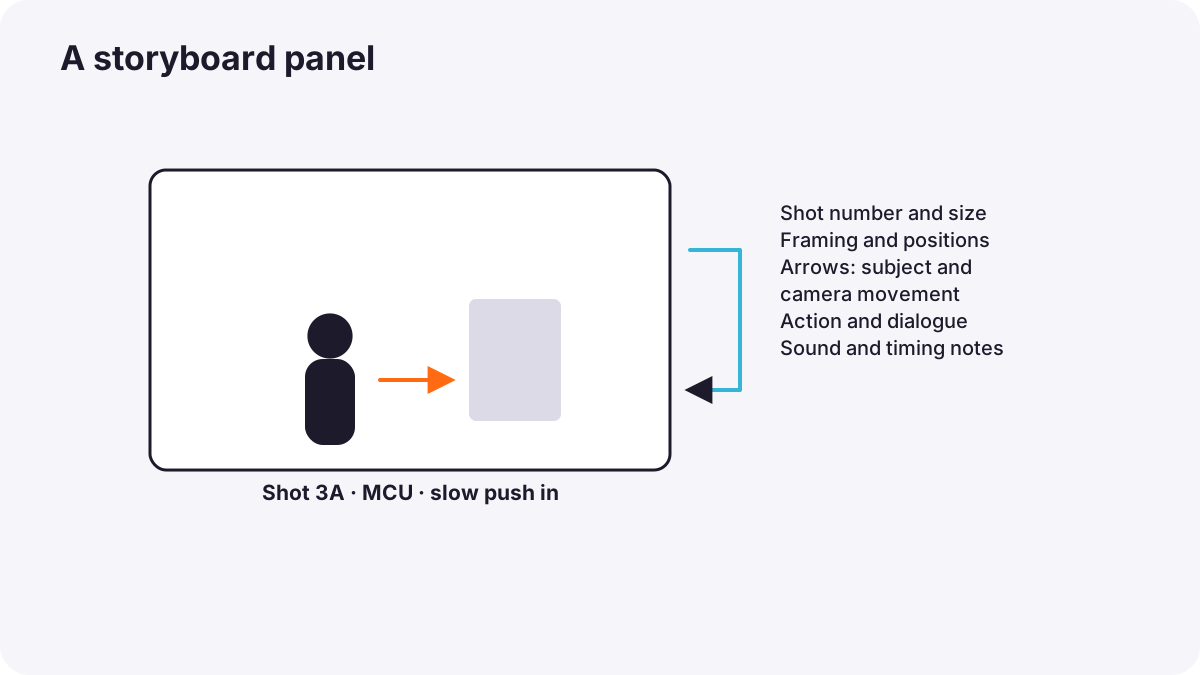
| Element | What it shows |
|---|---|
| Frame drawing | The shot size, angle and where people and objects are |
| Shot number | Scene and shot, such as 3A, 3B |
| Shot size and angle | For example MCU, low angle, as in shot sizes and camera angles for video |
| Movement arrows | Camera movement and subject movement |
| Action and dialogue | What happens and what is said |
| Sound and timing notes | Music, effects, approximate length |
Tip:Stick figures and simple boxes are enough. The goal is communication, not artwork. Some creators use photos of a quick rehearsal, simple 3D apps or AI sketches instead of drawings.
Showing movement
- Arrows inside the frame: show how people or objects move.
- Arrows outside or around the frame: show camera moves such as pans and push-ins, as in camera movement.
- A start and end frame: for long moves, draw both, joined by an arrow.
- Zoom and push symbols: boxes inside boxes show a push in or zoom.
Overhead floor plans
A floor plan, or overhead shot plan, is a simple map of the location seen from above. It shows where people stand, where they move, and where each camera position will be, often numbered to match the storyboard. It is the best way to check that all cameras stay on one side of the axis of action, as in continuity and the axis of action, and to plan lighting positions, as in professional lighting workflow.
Animatics and pre-visualization
An animatic is a storyboard turned into a simple video: the panels are timed and played in order, often with rough dialogue, music and sound. It shows the rhythm of a film before anything is filmed. Larger productions use pre-visualization, rough 3D animations of complex scenes such as action or visual effects.
From script to shot list
- Read the script or plan and break it into scenes, as in writing a simple script.
- Decide the key shots each scene needs to tell its story, as in visual storytelling in film.
- Draw a panel for each shot.
- Draw a floor plan for each location.
- Turn the panels into a shot list grouped by location and camera position for efficient filming, as in scheduling and assignment management.
- Share and review with the crew, client and performers.
Tip:Films are rarely shot in story order. The shot list groups shots so that all shots from one camera position or location are filmed together, saving time.
Common mistakes
- Skipping planning for complex scenes: time is wasted on set and key shots are missed.
- Worrying about drawing skill: simple sketches are enough.
- Treating the storyboard as unchangeable: real locations and performances may suggest better shots.
- No floor plan: cameras cross the line or lights appear in shot.
- Shooting in story order: moving cameras and lights back and forth wastes hours.
How productions plan shots
Professional productions storyboard commercials, action scenes, visual effects and important sequences, sometimes the whole film. Directors work with storyboard artists, cinematographers draw floor plans with camera and light positions, and assistant directors turn everything into a schedule. On set, the plan guides the day while leaving room to improve shots.
Practical examples
A 30-second advert
- Situation
- A client needs to approve a short product advert before filming.
- What to do
- You draw eight simple panels and make a timed animatic with temporary music.
- Why it works
- The client can see the story and rhythm before money is spent on filming.
- Result
- Changes are made on paper, and the shoot runs smoothly.
A dinner-table scene
- Situation
- Four people talk at a table, and earlier scenes confused viewers.
- What to do
- You draw a floor plan with the axis of action and number every camera position.
- Why it works
- The plan keeps all cameras on the correct side of the line.
- Result
- Clear, consistent coverage that cuts together.
Key points
- A storyboard is a sequence of simple drawings, one per shot, with notes on framing, movement and sound.
- Modern storyboards began at the Walt Disney studio in the early 1930s.
- Arrows show subject and camera movement; floor plans show positions from above.
- Animatics time the storyboard with sound to test rhythm before filming.
- Turn storyboards into a shot list grouped by location and camera position.
Frequently asked questions
Do I need to draw well to make a storyboard?
What is the difference between a storyboard and a shot list?
What is an animatic?
What is a floor plan in filmmaking?
Conclusion
Storyboards, floor plans and animatics let you see and fix a film before shooting it, and the shot list turns that plan into an efficient shoot. You have now completed the advanced composition and storytelling course for both photography and video.
Finished reading? Track your progress through Advanced composition.