A single photograph can tell a story in one frame. A film tells its story through many shots joined together, and the way they are joined creates meaning that no single shot contains. Put a face next to a plate of food and viewers think the person is hungry; put the same face next to a child and they think the person feels love. This lesson explains how video stories are built from shots, scenes and sequences, how editing creates meaning, and how filmmakers use reactions, motifs and pacing to guide the audience.
Shots, scenes and sequences
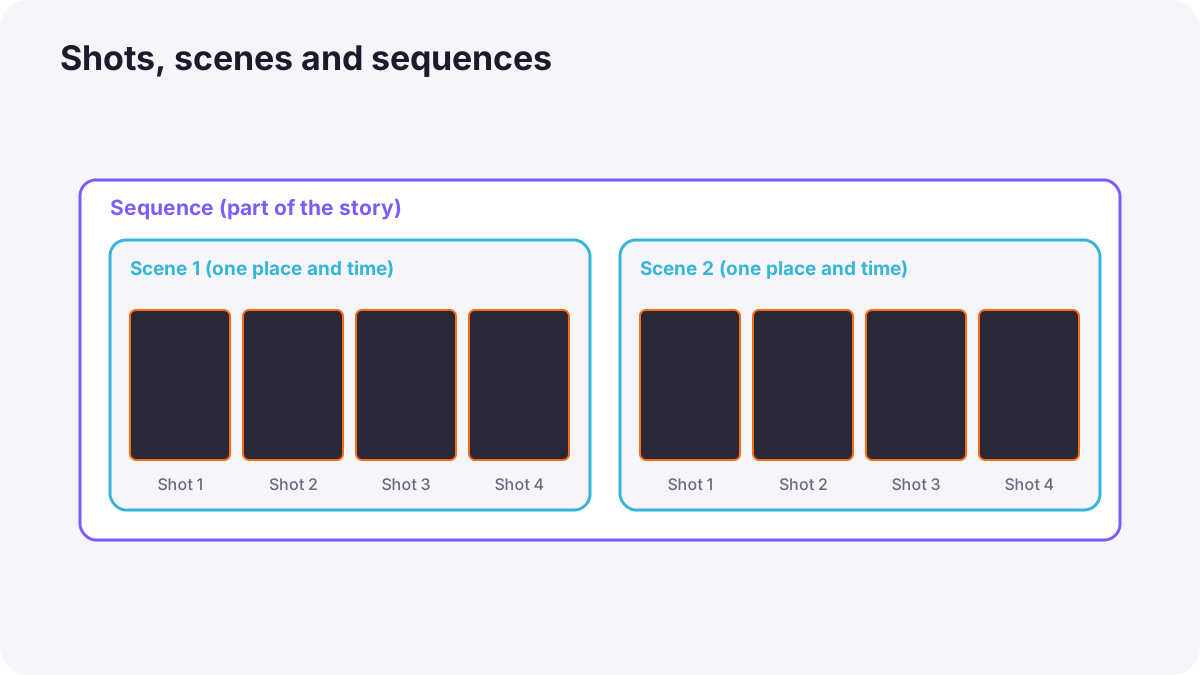
| Unit | What it is | Example |
|---|---|---|
| Shot | One continuous piece of film between two cuts | A close-up of a hand knocking on a door |
| Scene | A group of shots in one place and time | A visitor arrives and is welcomed inside |
| Sequence | A group of scenes that form one part of the story | The visitor's whole first day in a new city |
| Film | All the sequences together | The complete story |
Storytelling in still photography and photo essays was explained in building a visual narrative. Film adds time, movement and sound, so meaning grows from one shot to the next.
Meaning from shots placed together
In the early days of cinema, the Russian filmmaker Lev Kuleshov showed audiences the same expressionless face of an actor followed by different images, such as a bowl of soup, a child in a coffin, or a woman on a sofa. Viewers believed the actor showed hunger, grief or desire, even though his face never changed. This became known as the Kuleshov effect: viewers create meaning from the relationship between shots.
Montage means building meaning or emotion by joining shots in a deliberate order. Sergei Eisenstein, another early Russian filmmaker, made famous use of it. Today, a montage often means a fast series of shots that shows time passing, such as a training or travel montage.
The power of reaction shots
A reaction shot shows how a character responds to what happened. Viewers often learn more from the listener's face than from the speaker. Cutting to a reaction tells the audience how to feel and gives important moments weight. Shot sizes for reactions were explained in shot sizes and camera angles for video.
Building a scene
- Establish: show where we are with a wide shot.
- Introduce: show who is in the scene and what they want.
- Develop: move closer as the conversation or action builds.
- Peak: save the closest shots for the most important moment.
- Resolve: pull back or cut away as the scene ends.
Keep shots consistent so they cut smoothly, as in continuity and the axis of action. Story arcs across a whole film were introduced in building a visual narrative.
Show, don't tell
Films are strongest when the pictures, not explanations, carry the story, as in building a visual narrative. Instead of a character saying they are nervous, show shaking hands. Instead of saying a business is busy, show a full shop and a ringing phone.
- Visual motifs: a repeated image, color or object that gains meaning, such as an old watch that appears at key moments.
- Visual contrast: light and dark, crowded and empty, still and moving, to show change.
- Point of view: show what a character sees to share their experience.
Pacing and rhythm
Pacing is how fast the story moves, as introduced for photo sequences in sequences and photo essays. In film, short shots and quick cuts create energy and tension; long shots and slow cuts create calm, thought or sadness. Most good films change pace, giving viewers moments of excitement and moments to breathe. Editing rhythm is explained in pacing and rhythm.
Common mistakes
- Explaining everything with words: viewers lose interest when pictures repeat the dialogue.
- No reactions: important moments feel flat.
- Every shot the same size: scenes have no build and no peak.
- Random shot order: viewers cannot follow the action.
- The same pace throughout: the film feels monotonous.
How filmmakers tell stories visually
Directors and editors think in sequences: what each scene must show, which shots will carry it, and where the emotional peak falls. They plan reactions and inserts, use motifs and contrasts, and shape pace so the audience feels the story rather than being told it. Many great scenes work even with the sound turned off.
Practical examples
Showing a nervous job interview
- Situation
- You want viewers to feel a character's nerves before an interview.
- What to do
- You film close-ups of tapping fingers, a glance at the clock, a deep breath and a slow push in on the door.
- Why it works
- Details and reactions show the feeling without words.
- Result
- Viewers feel the tension before anyone speaks.
A family business story
- Situation
- A short film about a bakery feels like a list of facts.
- What to do
- You build it around the owner's day, with a repeated shot of the oven door opening as a motif.
- Why it works
- A character and a motif give the film structure and emotion.
- Result
- A warm story that viewers remember.
Key points
- Films are built from shots, scenes and sequences.
- The Kuleshov effect shows that viewers create meaning from how shots are placed together.
- Reaction shots tell viewers how to feel and give moments weight.
- Build scenes from wide to close, saving the tightest shots for the peak.
- Show rather than tell, use motifs and contrast, and vary pace.
Frequently asked questions
What is the difference between a shot, a scene and a sequence?
What is the Kuleshov effect?
What is a montage?
How do I tell a story without dialogue?
Conclusion
Visual storytelling in film comes from how shots are combined: building scenes from wide to close, using reactions, motifs and contrast, and shaping pace. Next, you will learn how to plan those shots in advance with storyboards and shot planning.
Finished reading? Track your progress through Advanced composition.