A script is the blueprint of a video. It tells everyone what will be seen and heard, scene by scene, so the team can plan, budget and film. You do not need to be a novelist to write a good script; you need a clear story, simple visual writing and dialogue that sounds like real people. This lesson explains how to develop an idea with a logline and treatment, the basic screenplay format, how to write visually, how to write natural dialogue, and the two-column format used for documentaries, adverts and corporate videos.
What a script is
A script, or screenplay, is a written document describing everything the audience will see and hear: locations, actions and dialogue. It is based on the story structure explained in story structure for short videos, and later turned into storyboards and shot lists, as in storyboards and shot planning.
From idea to script
| Step | What it is | Length |
|---|---|---|
| Logline | The whole story in one sentence: who wants what, and what stands in the way | One sentence |
| Outline | The main story beats in order | Half a page to a page |
| Treatment | The story told in prose, with tone and key scenes | One to a few pages |
| Script | Scene-by-scene actions and dialogue in script format | About one page per minute |
Basic screenplay format
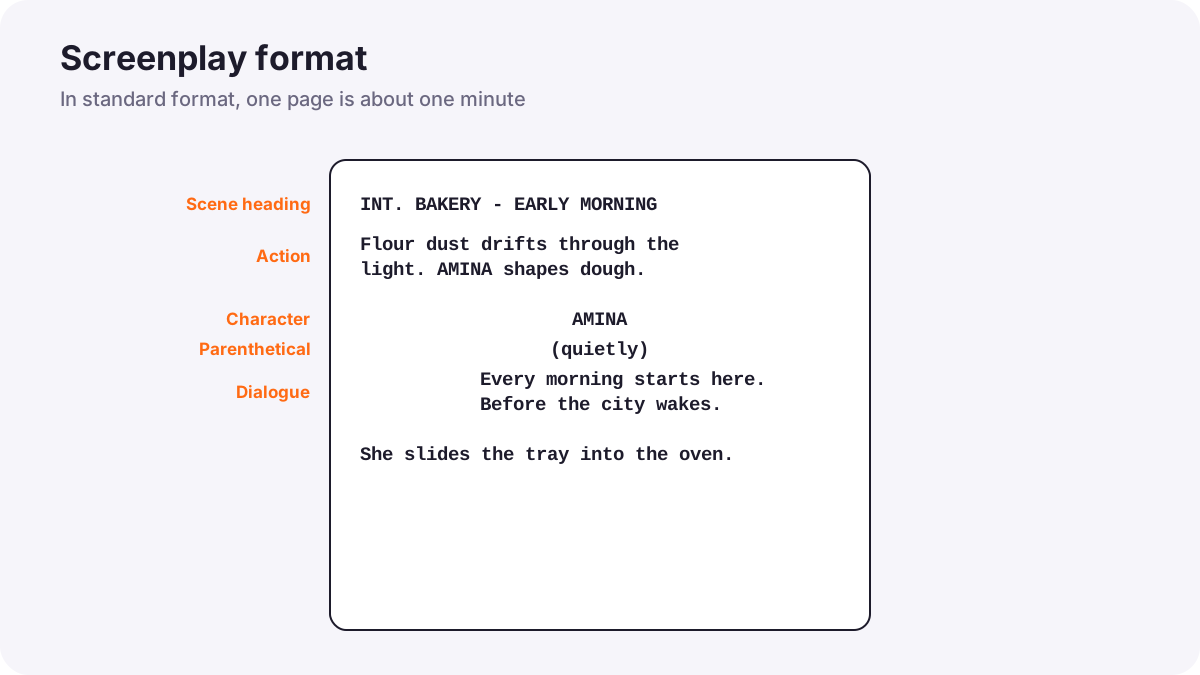
- Scene heading (slugline): INT. or EXT. (interior or exterior), the location and time, such as INT. KITCHEN - NIGHT.
- Action lines: short descriptions in the present tense of what we see and hear.
- Character name: in capitals above their dialogue.
- Dialogue: what the character says, in a narrower column.
- Parentheticals: very brief notes about how a line is said, used sparingly.
Remember:Screenplays are traditionally written in 12-point Courier font with standard margins. With this format, one page equals roughly one minute of screen time, which helps estimate length. Free and paid screenwriting software formats scripts automatically.
Writing visually
- Write only what can be seen or heard: not thoughts or backstory the camera cannot show.
- Show, don't tell: describe actions that reveal feelings, as in building a visual narrative.
- Keep action short: a few lines per paragraph, easy to read quickly.
- Avoid directing the camera: in a screenplay, describe what happens; shot choices come later with the director and cinematographer.
Writing natural dialogue
- Read it aloud: if it is hard to say, rewrite it.
- Keep lines short: people speak in fragments, not speeches.
- Let characters want something in every conversation.
- Use subtext: people often do not say exactly what they mean.
- Cut explanations: trust pictures and actions to carry information.
Two-column scripts
Documentaries, adverts, corporate and online videos often use a two-column script, sometimes called an AV script (audio-visual). The left column describes the pictures; the right column holds narration, interview lines, music and sound.
| Video | Audio |
|---|---|
| Wide shot: the bakery at sunrise, lights on | Music: gentle piano begins |
| Close-up: hands shaping dough | Narrator: 'Every morning starts here, before the city wakes.' |
| Medium shot: owner smiling at first customer | Owner (interview): 'This is the best part of my day.' |
For documentaries, the script is often written after filming, using interview transcripts and a paper edit, as in building the rough cut.
Writing and rewriting
- Write a quick first draft without stopping to perfect it.
- Check the structure: goal, conflict, change.
- Cut scenes and lines that do not move the story.
- Read the script aloud with others, a table read.
- Rewrite until every page earns its place, and check length against time and budget.
Common mistakes
- Writing what cannot be filmed: inner thoughts and long backstory.
- Long, stiff dialogue: performers sound unnatural.
- Too many locations and characters: the script cannot be made on the budget.
- No clear story: a sequence of scenes without purpose.
- Never reading aloud: awkward lines remain.
How writers and directors use scripts
Professional writers develop ideas through loglines, outlines and treatments before writing full scripts, use standard formats so pages equal screen time, write visually and economically, and rewrite after table reads. Directors then break scripts into shots and schedules, and documentary teams build two-column scripts from research and transcripts.
Practical examples
A 3-minute short film
- Situation
- Your idea is about a grandfather teaching his grandson to fish.
- What to do
- You write a logline, a half-page outline, then a three-page script with short visual action and little dialogue.
- Why it works
- Development steps keep the story clear and the length right.
- Result
- A filmable script about three minutes long.
A company explainer
- Situation
- A company wants a narrated video about its service.
- What to do
- You write a two-column script with pictures on the left and narration and music on the right.
- Why it works
- Two-column format matches picture and narration clearly.
- Result
- The client approves the script and the shoot is easy to plan.
Key points
- A script describes everything the audience will see and hear, scene by scene.
- Develop ideas through a logline, outline and treatment before the full script.
- Screenplay format uses scene headings, action, character names and dialogue; one page is about one minute.
- Write visually, keep action short and dialogue natural, and read it aloud.
- Use two-column scripts for documentaries, adverts and narrated videos.
Frequently asked questions
How do I write a script for a video?
How long is one page of a script?
What is a logline?
What is a two-column script?
Conclusion
A simple, clear script turns a story into a plan everyone can film: develop the idea, use a standard format, write visually and naturally, and rewrite. Next, you will learn how to block actors and camera.
Finished reading? Track your progress through Directing and filmmaking.