People follow creators who reliably give them something they want: a skill, a laugh, inspiration or useful information. A niche is the clear focus that makes you that reliable source. This lesson explains how to choose a niche you can sustain, how to describe your audience, what promise your content makes, and how successful creators grow beyond their first niche without losing their followers.
Topic, audience and value
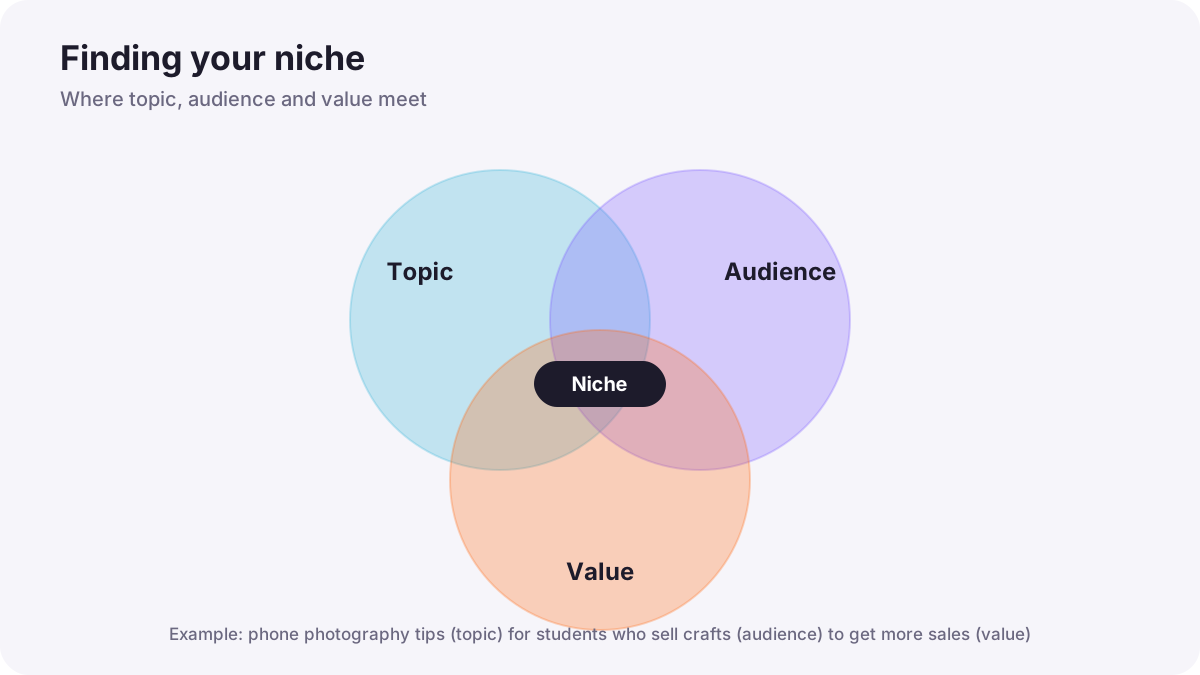
A niche has three parts: a topic (what you make content about), an audience (who it is for) and a value (what they get from it). "Phone photography" is a topic. "Phone photography tips for students who sell crafts online" is a niche, because it names the audience and the value.
Remember:This is the creator version of choosing a market and ideal client, explained in choosing services and defining a market.
The niche test
| Question | Good sign |
|---|---|
| Can I make 50 posts about it? | Ideas keep coming |
| Do I enjoy it enough for years? | You would make it even without views |
| Does a real audience want it? | People search for it and ask questions |
| Can I add something different? | Your skill, style or point of view |
| Can it lead to income? | Brands, products or services exist around it |
Describe your audience
- Who are they? Age range, interests and skill level.
- What do they want? To learn, to be entertained, to be inspired, to decide what to buy.
- What problems do they have? Their questions become your content ideas.
- Where do they spend time? Which platforms and formats they prefer.
Tip:Read the comments on popular videos in your topic. Viewers' questions are a free list of content ideas.
Your content promise
Write one sentence that tells people what they will get if they follow you, for example: "Simple phone photography tricks you can use today." Use it in your profile, and check every post against it. A clear promise also shapes your personal brand, as in personal brand and professional identity.
Growing beyond your first niche
Many large creators started narrow and expanded once they had a loyal audience, moving into related topics that the same people care about. Expanding too early confuses new viewers; expanding gradually brings followers with you.
Common mistakes
- A niche too broad, such as "lifestyle": nothing makes you memorable.
- A niche too narrow to sustain: you run out of ideas.
- Choosing only for money: it is hard to stay motivated.
- Changing topic every week: followers do not know what to expect.
How creators choose niches
Experienced creators test a few content ideas, watch which ones their audience responds to, and then commit. They describe their audience clearly, keep a written content promise and expand only into related topics.
Practical examples
From broad to clear
- Situation
- Your channel about "photography" grows slowly.
- What to do
- You focus on "night photography with phones for beginners".
- Why it works
- A clear audience and value make people subscribe for more.
- Result
- Viewers know what to expect, and growth improves.
Finding ideas
- Situation
- You run out of video ideas.
- What to do
- You collect questions from comments on popular videos in your niche.
- Why it works
- Audience questions show what people want.
- Result
- Months of relevant content ideas.
Key points
- A niche combines a topic, an audience and a value.
- Test a niche: 50 ideas, lasting interest, real demand, a different angle and income potential.
- Describe your audience's wants, problems and platforms.
- Write a one-sentence content promise and check every post against it.
- Expand gradually into related topics once you have a loyal audience.
Frequently asked questions
Do I need a niche?
What if my niche is too small?
Can I change my niche later?
How do I find content ideas?
Conclusion
A clear niche and audience make every content decision easier. Next, you will plan your content with pillars, calendars and batching.
Finished reading? Track your progress through Content creation.