Brands pay creators to reach audiences in an authentic way and to make content they can use in their own marketing. Working with brands professionally means knowing your value, communicating clearly, agreeing exactly what you will deliver and how it can be used, and always being honest with your audience about paid content. This lesson walks through the whole process, from a media kit to the final invoice.
Two kinds of brand work
- Sponsored posts: content on your channel featuring the brand, paid for your audience reach and trust.
- UGC (user-generated-style content): videos or photos made for the brand to post or advertise, paid for your creative skills, often without posting on your own channel.
A simple media kit
| Section | Contents |
|---|---|
| About you | Your niche and content promise |
| Audience | Followers, typical views, engagement, audience age and location |
| Best work | Examples, including past brand content |
| Services | Sponsored posts, UGC, photo packages |
| Contact | Email and links |
Remember:Keep numbers honest and current. Brands check, and trust is your most valuable asset.
Pitching and pricing
- Choose brands you already use and that fit your audience.
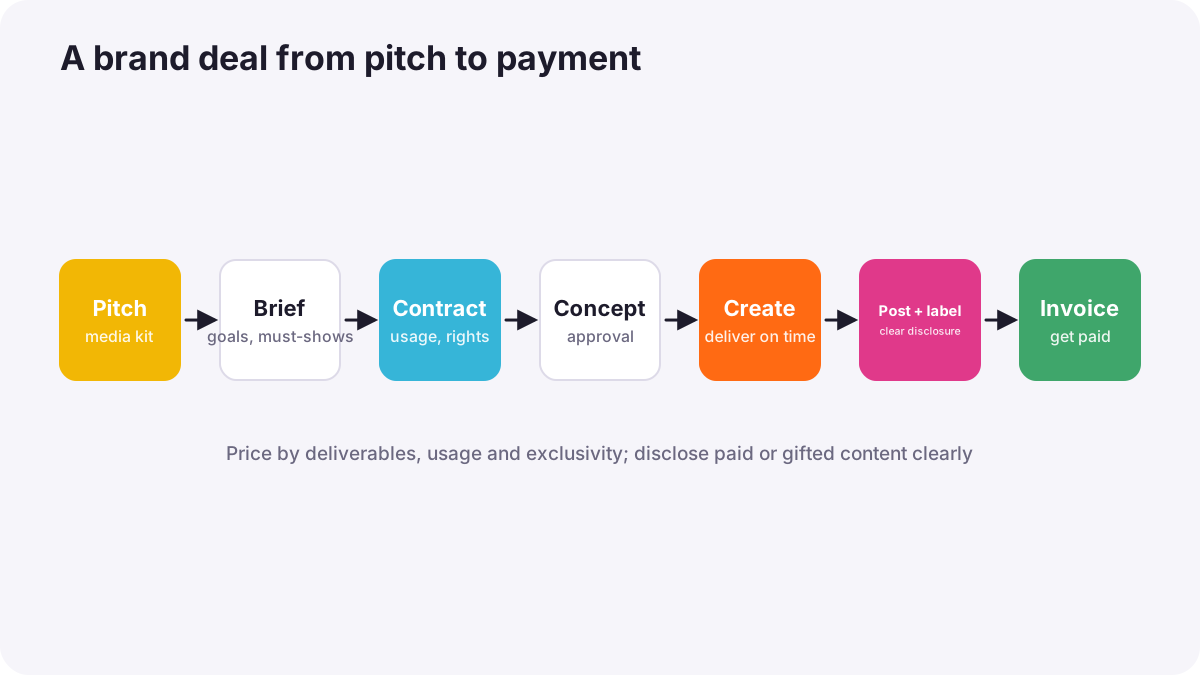
- Send a short, personal pitch: who you are, why the fit works, one idea and your media kit.
- Price by deliverables and usage: how many posts or videos, and how long and where the brand may use them.
- Charge more for exclusivity and paid advertising use, as in licensing and usage rights.
- Count all your time for planning, shooting, editing and revisions, as in estimating costs, time and value.
Briefs, contracts and delivery
- Read the brief carefully: goals, key messages, must-show items and things to avoid.
- Agree in writing: deliverables, deadlines, payment, revisions, usage rights and exclusivity, as in contracts and client communication.
- Share a concept or script for approval before filming.
- Deliver on time in the agreed formats, then invoice.
Disclosure: always be honest
Advertising rules in many countries require creators to clearly disclose paid or gifted content, for example with labels such as "ad" or "paid partnership" placed where viewers see them immediately. Platforms also have their own branded-content tools. Rules differ by country, so follow both your local rules and the platform's.
Remember:Disclosure protects your audience's trust. Hidden ads damage your reputation and can break the law.
Common mistakes
- Accepting every offer: unrelated brands confuse your audience.
- Working without a written agreement: disputes about usage and payment.
- Giving unlimited usage for a small fee: undervaluing your work.
- Hidden or unclear disclosure: lost trust and legal risk.
How professional creators handle brand deals
Professional creators keep an updated media kit, pitch selectively, price by deliverables and usage, agree everything in writing, deliver on time and disclose every paid relationship clearly. Brands return to creators who are reliable and easy to work with.
Practical examples
A first pitch
- Situation
- You use a small camera-strap brand and love it.
- What to do
- You send a short pitch with an idea for a travel video and your media kit.
- Why it works
- A genuine fit and clear idea make pitches stronger.
- Result
- A paid sponsored video.
A UGC request
- Situation
- A skincare brand wants three videos for its ads.
- What to do
- You price the videos plus six months of paid advertising usage and agree it in writing.
- Why it works
- Advertising usage has extra value.
- Result
- Fair pay and clear rights.
Key points
- Sponsored posts pay for your reach and trust; UGC pays for your creative skills.
- A media kit shows your niche, honest audience numbers, best work and services.
- Price by deliverables and usage, and charge more for exclusivity and advertising use.
- Agree deliverables, deadlines, payment, revisions and rights in writing.
- Always disclose paid or gifted content clearly.
Frequently asked questions
What is a media kit?
How much should I charge brands?
What is UGC?
Do I have to say a post is an ad?
Conclusion
Professional brand work is clear, fair and honest. Next, you will learn how to stay safe and healthy as a creator.
Finished reading? Track your progress through Content creation.