On social platforms, viewers decide in a few seconds whether to keep watching. A strong hook earns those seconds, and good structure keeps people to the end. This lesson goes beyond the basic hook to explain a simple hook-promise-payoff structure, editing techniques that hold attention, how to end videos so people watch again or act, and how storytelling makes short videos memorable.
Hook, promise and payoff
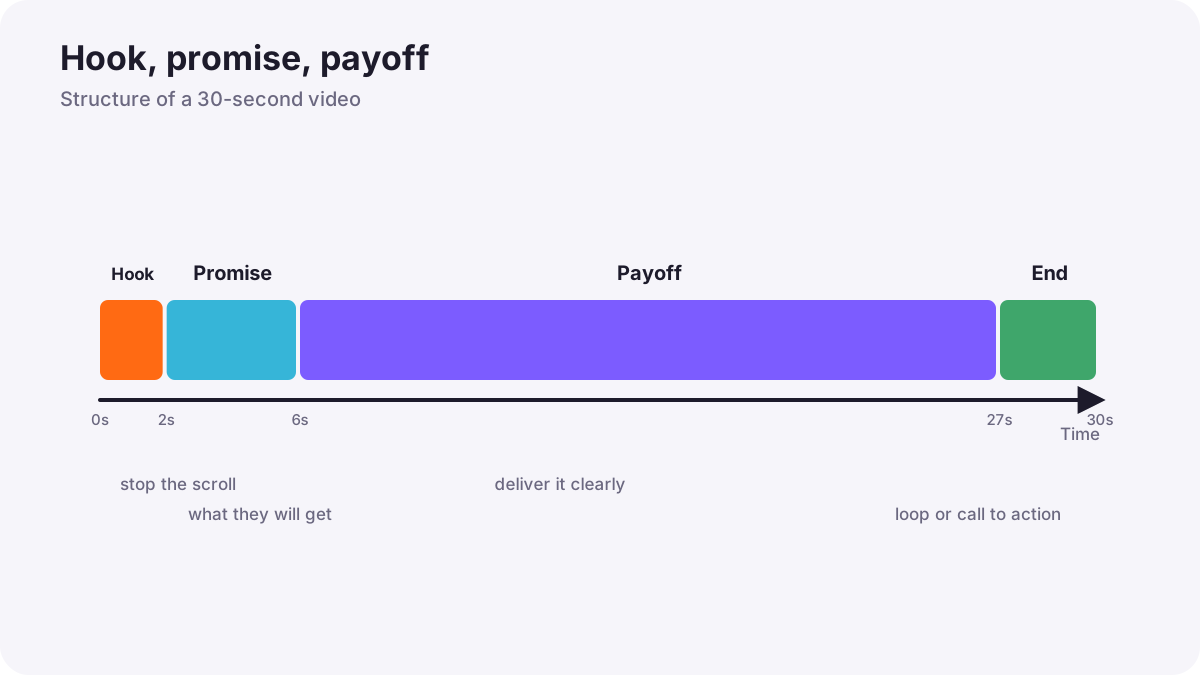
A hook is the opening moment that stops people scrolling, introduced in short-form vertical video for social media. A strong short video then follows three steps:
- Hook: a surprising image, question or result in the first second or two.
- Promise: tell viewers what they will get if they keep watching.
- Payoff: deliver exactly what you promised, clearly and quickly.
Remember:Retention means how much of a video viewers watch. Videos that keep people watching are usually shown to more people.
Types of hooks
| Hook type | Example |
|---|---|
| Show the result first | The finished photo, then how it was made |
| Ask a question | Why do your night photos look blurry? |
| Bold statement | This one setting fixed my phone videos |
| Before and after | Split screen of the edit |
| Movement or action | Something happening in the first frame |
| Curiosity gap | Start the story in the middle |
Tip:Use text on screen in the first second as well as speech, because many people watch without sound.
Keeping attention
- Cut every pause and repetition, as in pacing and rhythm.
- Change the picture every few seconds: a new angle, close-up, text or B-roll.
- Use pattern breaks: a sound effect, a zoom-in, a surprising cut.
- Show, do not only tell: demonstrate the tip on screen.
- Keep one idea per video.
Storytelling in short videos
Even a 30-second video can tell a story: a person with a problem, an attempt and a change, as in story structure for short videos. Stories create emotion, and emotional videos are more likely to be shared and remembered.
Endings that work
- Loop: end on a frame that flows back to the start, so people watch again.
- Clear call to action: follow for part 2, save this for later, comment your answer.
- Quick ending: stop as soon as the payoff is delivered.
Common mistakes
- Slow introductions: "Hi everyone, welcome back" loses viewers.
- Clickbait hooks with no payoff: viewers feel tricked and leave.
- Several ideas in one short video: confusing and forgettable.
- Long endings after the payoff: lower retention.
How professional creators hold attention
Professional creators script the first seconds carefully, test different hooks for the same content, watch where viewers leave in their analytics, and edit tightly so every second earns its place, while always delivering what the hook promised.
Practical examples
A lighting tip
- Situation
- Your tip video loses most viewers in the first three seconds.
- What to do
- You open with a dramatic before-and-after split screen and the text "One lamp did this."
- Why it works
- Showing the result first creates curiosity.
- Result
- Many more people keep watching.
A travel clip
- Situation
- Your travel video is a list of pretty shots.
- What to do
- You add a small story: missing the sunset, running up the hill, then the reward.
- Why it works
- A story with a problem and payoff creates emotion.
- Result
- More shares and comments.
Key points
- Use a hook, a promise and a payoff.
- Hooks can show the result, ask a question, make a bold statement or start mid-story.
- Hold attention by cutting pauses, changing the picture often and keeping one idea per video.
- Tell small stories and end with a loop, a clear call to action or a quick finish.
- Never use hooks that the video does not deliver.
Frequently asked questions
What is a hook in a video?
How long should a hook be?
What is retention?
Is clickbait a good idea?
Conclusion
Hooks earn attention and structure keeps it. Next, you will apply these ideas to longer YouTube videos.
Finished reading? Track your progress through Content creation.