Every filmmaker, from beginner to master, improves the same way: make something, watch it honestly, learn from others' reactions, study great work, and make the next film better. Reviewing your own films can be uncomfortable, but it is the fastest path to growth. This final lesson gives you a practical self-review checklist for story, picture, sound and editing, explains how to run test screenings and gather useful feedback, how to study other films, and how to build a personal learning plan that keeps you improving.
Why review matters
Reviewing means watching your finished work carefully, measuring it against your intentions, and turning what you learn into specific improvements. Critique methods for photographs were explained in how to critique a photograph, group critique and self-assessment in portfolio review, and project reflection in sequencing and final presentation. Film review uses the same habits, applied to story, motion, sound and editing.
A self-review checklist
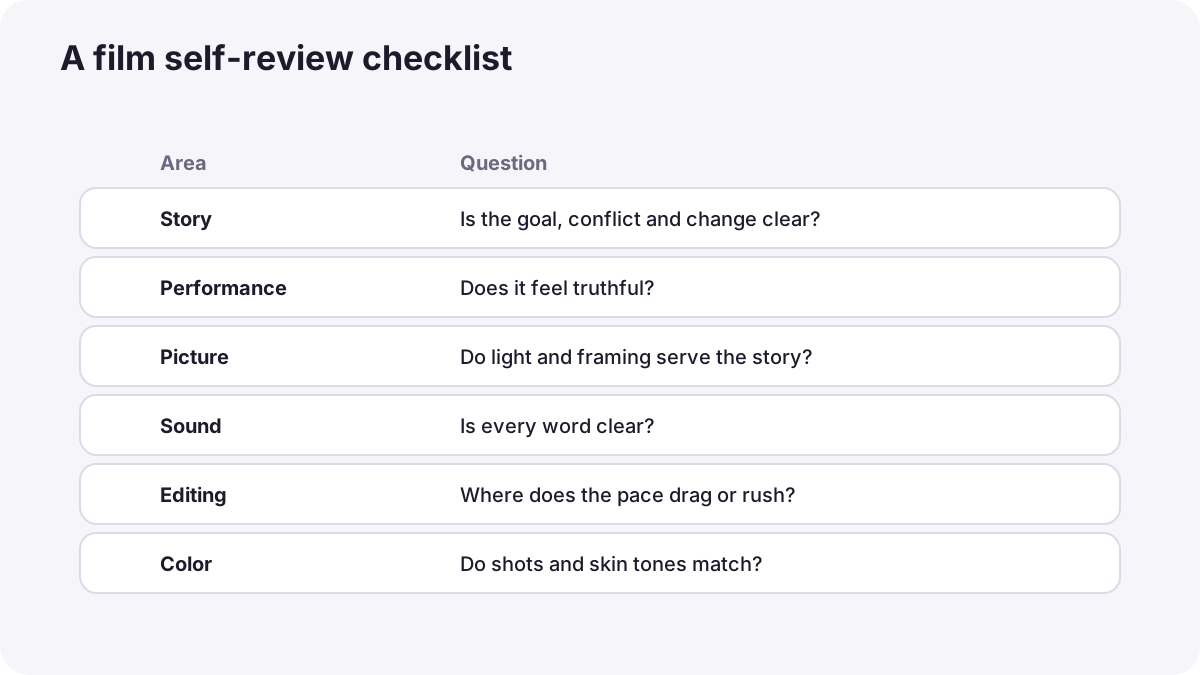
| Area | Questions |
|---|---|
| Story | Is the goal, conflict and change clear? Does every scene move the story forward? |
| Performance | Do people feel truthful? Where did a performance feel forced? |
| Picture | Are exposure, focus, framing and movement serving the story? |
| Sound | Is every word clear? Do ambience, effects and music support the mood? |
| Editing | Where did the pace drag or rush? Are any cuts confusing? |
| Color | Do shots match? Do skin tones look natural? Does the look fit the story? |
| Purpose | Did the film make viewers feel what you intended? |
Tip:Watch your film again a few days after finishing it. Distance helps you see it more like a new viewer.
Test screenings
- Show it to a small group who match your intended audience.
- Watch the audience, not the screen: notice laughter, silence, restlessness and phones.
- Ask open questions afterward: What was the story about? Where were you confused? What moment stayed with you?
- Listen without defending: your explanation does not exist for future viewers.
- Look for patterns: if several people mention the same moment, it needs attention.
Using feedback well
- Separate problems from suggested solutions: viewers are good at noticing problems; you decide how to fix them.
- Prioritize: fix story and clarity first, then sound, then visual polish.
- Keep your vision: not every suggestion should be followed.
- Thank people: honest feedback is a gift.
Studying other films
- Watch films twice: once for enjoyment, once to study how they work.
- Analyze one element at a time: lighting, shot sizes, cuts, sound or color.
- Break down a scene: list every shot and its purpose.
- Study widely: films from different countries, eras and genres, as in studying photographers and photographic movements.
- Imitate to learn, then develop your own voice, as in developing a recognizable visual style.
A personal learning plan
- Choose one or two skills to improve in your next project, such as sound or coverage.
- Set a small practice project focused on those skills.
- Review the result with the checklist.
- Keep a notebook of lessons learned from each film.
- Repeat: make many short projects rather than waiting for one perfect film.
Remember:Improvement comes from finishing many projects. Each completed film, even a small one, teaches more than a perfect plan that is never made.
Common mistakes
- Never watching your own work again: the same mistakes repeat.
- Only asking friends who praise everything: no useful feedback.
- Defending the film during feedback: you stop learning.
- Trying to fix everything at once: progress feels overwhelming.
- Comparing yourself harshly to masters: discouragement instead of learning, as in developing visual judgment.
How filmmakers keep growing
Professional filmmakers review their work honestly, hold test screenings, gather feedback from trusted collaborators, study films constantly and set focused goals for each new project. They accept that every film has flaws, learn from them, and keep making work. Growth is a habit, not a single achievement.
Practical examples
A confusing middle
- Situation
- At a test screening, three viewers say they were lost in the middle of your short.
- What to do
- You add a short establishing shot and remove a scene that repeated information.
- Why it works
- Patterns in feedback point to real problems.
- Result
- The story becomes clear.
Sound as a learning goal
- Situation
- Your self-review shows sound is the weakest part of your films.
- What to do
- You make two practice videos focused only on recording and mixing dialogue.
- Why it works
- Focused practice on one skill improves it quickly.
- Result
- Clearly better sound in your next short film.
Key points
- Reviewing means watching your work honestly against your intentions and turning lessons into improvements.
- Use a checklist for story, performance, picture, sound, editing, color and purpose.
- Run test screenings, watch the audience, ask open questions and look for patterns.
- Study other films one element at a time, from many countries and genres.
- Set focused learning goals and keep finishing projects.
Frequently asked questions
How do I improve as a filmmaker?
What is a test screening?
How should I handle negative feedback?
How can I learn from other films?
Conclusion
Filmmakers improve by reviewing honestly, testing with audiences, studying great work and practicing focused skills, one film after another. You have now completed the directing and filmmaking course and the full photography and videography Academy. Keep creating, keep reviewing and keep growing.
Finished reading? Track your progress through Directing and filmmaking.