Whether it lasts thirty seconds or thirty minutes, a video that tells a story holds attention far better than one that simply shows things. Stories follow patterns that audiences understand almost instinctively: someone wants something, something stands in the way, and something changes. This lesson explains the three-act structure, the role of character, goal and conflict, key moments such as the inciting incident and the climax, and simple structures for short films, brand videos, documentaries and social videos.
What story structure is
Story structure is the order and shape of events that carry the audience from the beginning to the end of a story. The story arc and visual narrative for photo stories were introduced in building a visual narrative, and storytelling with shots and scenes in visual storytelling in film. This lesson applies them to scripted and real stories on video.
The three-act structure
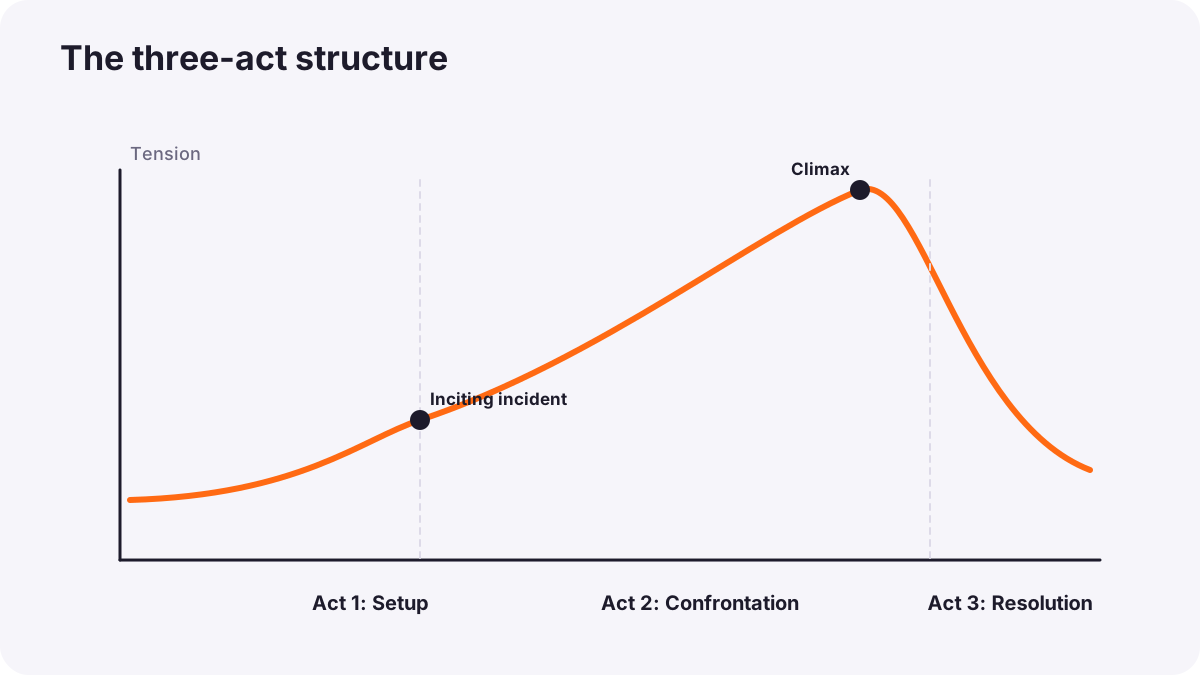
| Act | What happens | In a 3-minute short film |
|---|---|---|
| Act 1: Setup | Introduce the character, their world and what they want; something disrupts it | About the first 30 to 45 seconds |
| Act 2: Confrontation | The character tries to reach the goal and meets obstacles; tension rises | The longest part, about 1.5 to 2 minutes |
| Act 3: Resolution | The climax, the biggest moment, then the result and what has changed | The last 30 to 45 seconds |
Remember:The three-act structure is not a strict rule, but it is used in stories all over the world because it matches how people expect change to unfold.
Character, goal and conflict
- Character: someone the audience can care about, a person, team, animal or even a product.
- Goal: what they want, clear enough to understand quickly.
- Conflict: what stands in the way: a person, a problem, nature, time or their own fear.
- Stakes: what happens if they fail; higher stakes create more interest.
- Change: by the end, something is different: the situation, the character or the audience's view.
Key story moments
| Moment | What it is |
|---|---|
| Hook | The opening that makes viewers want to keep watching |
| Inciting incident | The event that starts the story and sets the goal |
| Turning points | Moments when the situation changes direction |
| Climax | The highest point of tension, where the goal is won or lost |
| Resolution | What happens after, and what it means |
Hooks for short social videos were explained in short-form vertical video for social media.
Structures for different videos
| Video type | Simple structure |
|---|---|
| Short film | Setup, rising conflict, climax, resolution |
| Brand or product video | Problem, solution, result, invitation to act |
| Documentary portrait | Who they are, what challenge they face, what they do, what it means |
| Tutorial | Promise of the result, steps, final result |
| Social clip | Hook, one development, payoff in seconds |
| Event highlight | Anticipation, key moments building, emotional peak, closing image |
Planning a short story
- Write one sentence: who wants what, and what stands in the way.
- Decide the ending first: what changes, and how should viewers feel?
- Choose the inciting incident and climax.
- Cut everything that does not support the goal, conflict or change.
- Plan shots for each story beat, as in storyboards and shot planning.
Tip:Short videos have no time for long setups. Start as late in the story as you can, and end as soon as the change is clear.
Common mistakes
- No clear goal: viewers do not know what to care about.
- No conflict: nothing is at stake, so nothing is interesting.
- Long introductions: viewers leave before the story begins.
- Too many characters or ideas: the story becomes confusing.
- No change at the end: the video feels pointless.
How storytellers structure short work
Professional writers and directors define the character, goal, conflict and change before anything else, outline story beats, and test whether every scene moves the story forward. Advertising and documentary teams use the same principles, adapting structure to the length and platform, and refine it again in the edit, as in building the rough cut.
Practical examples
A 60-second brand video
- Situation
- A bicycle repair shop wants a short story, not a list of services.
- What to do
- You show a cyclist whose bike breaks before a race, the mechanic fixing it, and the cyclist crossing the finish line.
- Why it works
- Problem, solution and result create a simple story arc.
- Result
- A memorable video that shows the shop's value.
A short film that dragged
- Situation
- Your 5-minute film spends 2 minutes introducing the character.
- What to do
- You start the film at the moment the character receives an unexpected letter.
- Why it works
- Starting at the inciting incident hooks viewers immediately.
- Result
- A tighter, more engaging film.
Key points
- Story structure is the order and shape of events from beginning to end.
- Three acts: setup, confrontation and resolution.
- Stories need a character, a goal, conflict, stakes and change.
- Key moments include the hook, inciting incident, turning points, climax and resolution.
- Adapt simple structures to each video type, and start as late and end as soon as possible.
Frequently asked questions
What is the three-act structure?
What is an inciting incident?
How do I tell a story in a short video?
Do brand videos need a story?
Conclusion
Clear story structure, with a character, goal, conflict and change shaped into acts and key moments, makes even very short videos engaging. Next, you will learn how to write a simple script.
Finished reading? Track your progress through Directing and filmmaking.