Before the camera rolls on a scene, the director decides where people stand, when they move, where they look and how the camera follows them. This is called blocking. Good blocking makes scenes feel natural, keeps the story clear, creates strong images and lets the crew light and record sound efficiently. Poor blocking leaves actors stiff, shots flat and the editor without usable angles. This lesson explains how to plan blocking, motivate movement, stage scenes in depth, use marks, rehearse, and block the camera together with the actors.
What blocking is
Blocking is the planned positions and movements of performers and the camera in a scene. The word comes from theatre. In film, blocking must work for the camera, the lights and the microphones as well as for the performers. Camera movement was explained in camera movement, and composition in depth in layering and depth.
Motivated movement
Every movement should have a reason in the story or the character's situation: crossing to the window to avoid a question, standing up in anger, moving closer to comfort someone. Motivated movement feels natural and reveals emotion without words, as in visual storytelling in film.
- Moving toward someone: closeness, aggression or care.
- Moving away: avoidance, fear or independence.
- Standing above someone: power; sitting below: vulnerability.
- Stillness: focus, shock or control.
Staging in depth
Staging in depth means placing people and objects at different distances from the camera, foreground, middle ground and background, instead of lining them up flat against a wall. It creates depth, lets one shot show relationships, and gives the eye somewhere to travel. Famous directors such as Akira Kurosawa and Orson Welles often staged several people at different depths in one shot.
Foreground, middle ground and background were introduced in depth, foreground and layering.
A blocking process
- Read the scene and decide its purpose and emotional turning point.
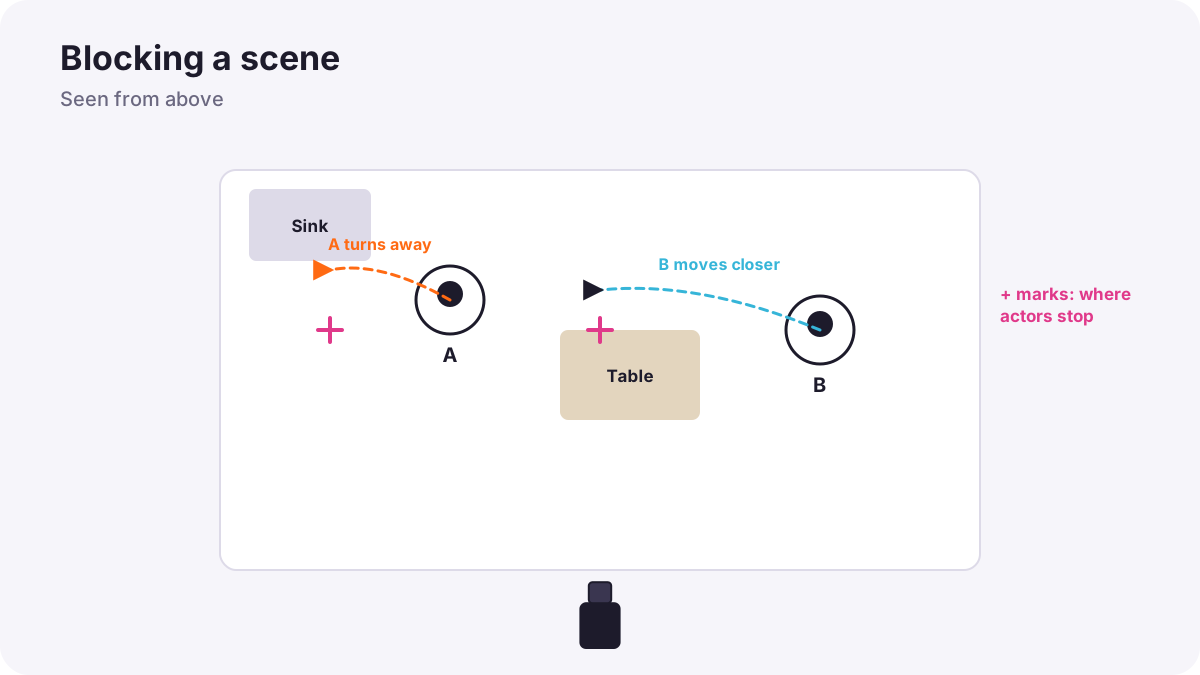
- Sketch a floor plan with furniture, doors, windows and possible movement, as in storyboards and shot planning.
- Walk the scene with the performers, letting natural movement suggest ideas.
- Set the camera positions to cover the blocking, keeping the axis of action clear, as in continuity and the axis of action.
- Place marks on the floor where performers stop.
- Rehearse for camera, focus, lights and sound, then film.
Marks
Marks are small pieces of tape or chalk on the floor showing where a performer should stop. They let the camera operator, focus puller and lighting team know exactly where people will be, as in focus for video. Each performer may have different colored marks, and marks are removed or hidden from the shot.
Blocking for the whole crew
- Camera: the camera moves with the blocking, or holds while performers move through the frame.
- Lighting: performers must stop in lit positions, as in professional lighting workflow.
- Sound: the boom operator plans positions to follow each line, as in shotgun and boom microphones.
- Continuity: actions must repeat the same way in every take, as in continuity and the axis of action.
Tip:Block simply first. Natural movement and a clear story matter more than complex choreography, especially on small productions.
Common mistakes
- Performers standing in a flat line: lifeless images.
- Movement without reason: scenes feel staged.
- No marks: focus and lighting miss the performers.
- Blocking that ignores sound: lines are spoken where the microphone cannot reach.
- Blocking that crosses the line: confusing edits.
How directors block scenes
Directors usually block with the performers first, in a short rehearsal for the key crew, then decide camera positions to cover it. The camera, lighting, sound and focus teams then prepare while stand-ins hold the marks. Good directors keep blocking motivated and flexible, and adjust if a performer finds a more truthful movement.
Practical examples
An argument in a kitchen
- Situation
- Two characters argue, but the scene feels static.
- What to do
- You block one character turning to the sink to avoid the other, who moves closer with each line.
- Why it works
- Motivated movement shows avoidance and pressure.
- Result
- The scene gains tension without extra dialogue.
Soft focus on the key line
- Situation
- A performer drifts forward and is out of focus on the most important line.
- What to do
- You add a floor mark and rehearse the stop with the focus puller.
- Why it works
- Marks give the crew exact positions.
- Result
- Sharp focus on every take.
Key points
- Blocking is the planned positions and movements of performers and the camera.
- Movement should be motivated by story and character.
- Staging in depth creates depth and shows relationships in one shot.
- Plan with a floor plan, walk the scene, set camera positions and place marks.
- Blocking must work for camera, lighting, sound and continuity; keep it simple and truthful.
Frequently asked questions
What is blocking in film?
What are marks in filmmaking?
What is staging in depth?
Should I block with actors or plan alone?
Conclusion
Good blocking places people and the camera with purpose: motivated movement, depth, clear marks and a plan that works for the whole crew. Next, you will learn how to direct people on camera.
Finished reading? Track your progress through Directing and filmmaking.