The camera, lights and microphones capture an interview, but the interviewer creates it. The way you prepare, ask and listen decides whether people give short, nervous answers or open up with clear, moving stories. Good interviewing is a skill of curiosity, patience and respect. This lesson explains how to prepare, write open questions, help people answer in full sentences, listen without interrupting, follow up, handle sensitive topics with care, and use interviews honestly in the edit.
What a good interview is
A good video interview gives clear, natural answers that tell a story in the person's own words and can be edited without the interviewer's voice. Filming and lighting interviews were explained in interview and documentary filming and interview lighting; this lesson is about the conversation itself.
Preparation
- Research the person and topic so you can ask informed questions, as in research and visual references.
- Pre-interview: a short, friendly call before filming to learn their story and put them at ease.
- Know the story you need and the moments you hope to capture, as in story structure for short videos.
- Write questions in an order that moves from easy to deeper topics.
- Explain the process: how long it will take, how the video will be used, and that mistakes can be redone.
Asking good questions
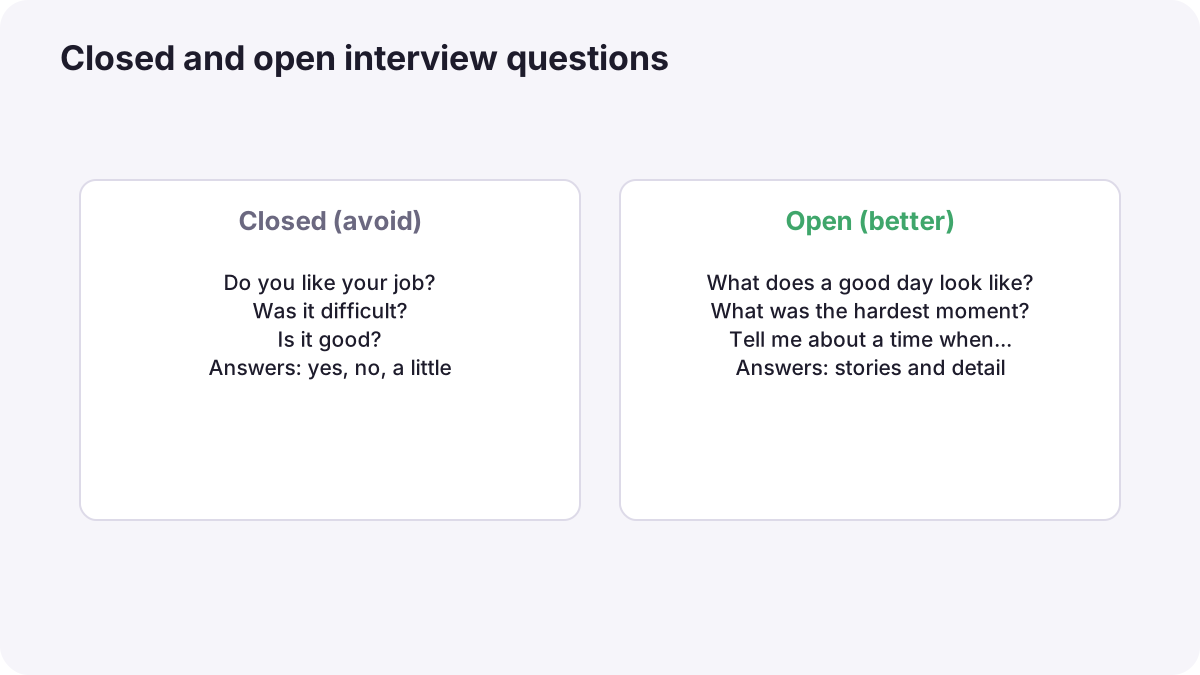
| Closed (avoid) | Open (better) |
|---|---|
| Do you like your job? | What does a good day at work look like for you? |
| Was it difficult? | What was the hardest moment, and how did you get through it? |
| Is your product good? | Tell me about a customer whose life changed because of this. |
- Ask for stories: 'Tell me about a time when...' produces vivid answers.
- Ask one question at a time: long, double questions confuse people.
- Ask about feelings and details: 'What did you see? How did it feel?'
Full-sentence answers
If the interviewer's voice will be removed, answers must make sense alone. Ask the person to include the question in their answer: if asked 'When did you start baking?', they say 'I started baking when I was twelve' rather than 'When I was twelve'. Explain this gently at the start, and ask again if needed.
Listening
- Stay silent while they speak: nod instead of saying 'mm' or 'yes', which would overlap their answer.
- Use silence: after an answer, wait a few seconds; people often add their most honest thoughts.
- Follow up: 'Can you tell me more about that?' or 'What happened next?'
- Look at them, not your notes: eye contact helps the eyeline and the connection, as in interview and documentary filming.
- Listen for sound problems: repeat a question if a noise covered an answer.
Tip:End every interview with 'Is there anything I didn't ask that you would like to say?' Some of the best answers come from this question.
Sensitive topics
- Explain in advance which topics you hope to discuss.
- Let people stop or skip questions at any time.
- Be patient and kind with emotional moments; offer a break.
- Protect vulnerable people and think about the effect the film may have on them, as in ethics in documentary and candid photography.
Honest use of answers
Edit interviews to be clear and concise, but never change the meaning of what someone said, as explained in editing dialogue and interviews. Get consent and releases for how the interview will be used, as in filming people and places.
Common mistakes
- Closed questions: one-word answers.
- Speaking over answers: unusable audio.
- Answers that need the question: they cannot stand alone in the edit.
- Rushing to the next question: the best thoughts are lost.
- Pressuring people on painful topics: harm and lost trust.
How documentary interviewers work
Experienced interviewers research deeply, build trust before filming, ask open, story-based questions one at a time, listen silently and use pauses, follow interesting threads, and treat people's stories with care. They work closely with the camera and sound team so the conversation feels private and relaxed.
Practical examples
One-word answers
- Situation
- A craftsman answers 'Yes' and 'About ten years' to your questions.
- What to do
- You switch to 'Tell me about the first piece you ever made' and wait quietly.
- Why it works
- Open, story questions and silence invite fuller answers.
- Result
- A warm, detailed story you can edit.
Answers that do not stand alone
- Situation
- Your edit needs the speaker's answer without your question.
- What to do
- You ask her to include the question in her answer and repeat the best answers.
- Why it works
- Full-sentence answers make sense on their own.
- Result
- Clean answers that cut easily into the story.
Key points
- Good interviews give clear, natural answers that tell a story in the person's own words.
- Research, pre-interview, plan questions from easy to deep, and explain the process.
- Ask open, story-based questions one at a time, and request full-sentence answers.
- Listen silently, use pauses, follow up and end by asking what you missed.
- Handle sensitive topics with care and use answers honestly.
Frequently asked questions
How do I ask good interview questions?
Why should interviewees answer in full sentences?
Should I say 'mm-hmm' during answers?
What should I ask at the end of an interview?
Conclusion
Great interviews come from preparation, open questions, full-sentence answers, silent listening, careful follow-ups and respect. Next, you will learn coverage: how to film a scene so the editor has everything needed.
Finished reading? Track your progress through Directing and filmmaking.