Big films have hundreds of crew members, but most videos, from short films to brand content and documentaries, are made by small teams of two to ten people. A small crew can move quickly and work closely together, but everyone must cover several jobs, communicate clearly and look after each other. This lesson explains the essential roles on a small shoot, how to combine them, how to communicate and behave on set, how to keep everyone safe, and how to handle agreements, credits and respect.
Essential roles
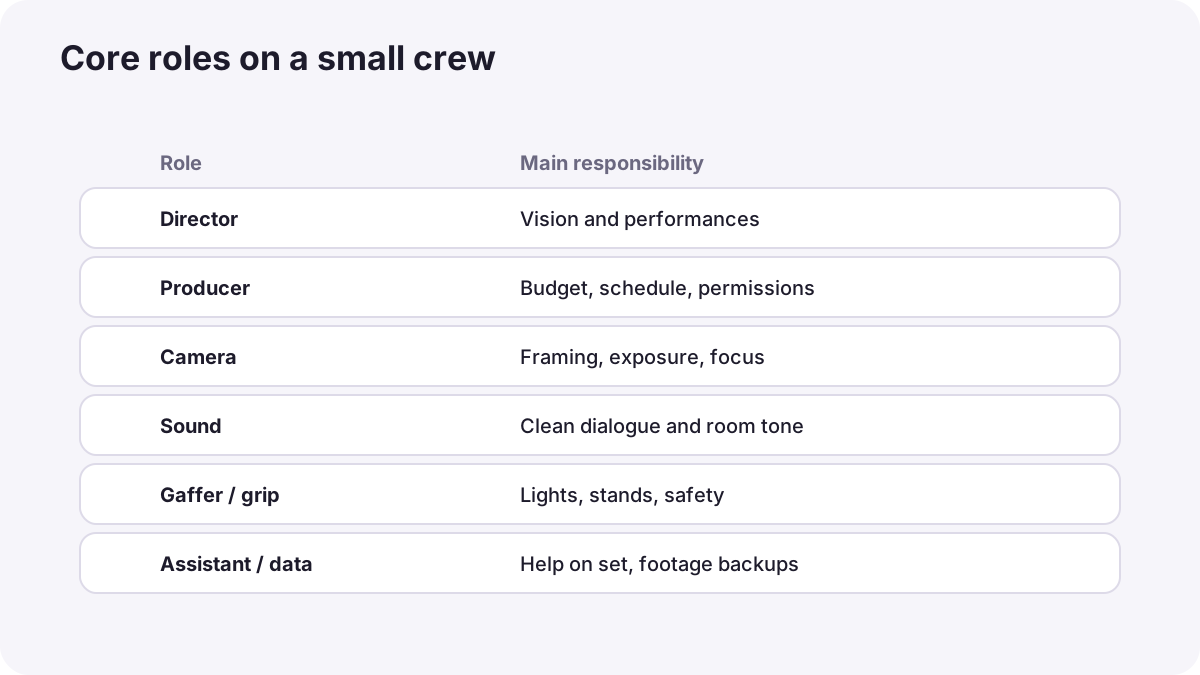
| Role | Main responsibility |
|---|---|
| Director | Creative vision and performances, as in what a director does |
| Producer | Budget, schedule, locations, permissions and logistics |
| Camera operator or cinematographer | Framing, movement, exposure and focus |
| Sound recordist | Clean dialogue and sound, as in why sound matters in video |
| Gaffer and grip | Lights, stands, power and safe rigging |
| Production assistant | Helping wherever needed: equipment, people, food, errands |
| Data wrangler | Offloading and backing up footage, as in offloading and backing up video footage |
Combining roles
- Common combinations: director and producer; camera and lighting; sound and data.
- Never combine camera and sound on important dialogue if you can avoid it; both need full attention.
- Write down who does what so nothing is forgotten.
- Be realistic: plan fewer setups when people carry several jobs.
Clear communication
- Call sheet: send times, locations, contacts, schedule and safety details the day before, as in scheduling and assignment management.
- Morning briefing: share the plan for the day and any safety points.
- Standard calls: 'quiet please', 'rolling', 'action', 'cut', so everyone knows what is happening.
- One voice at a time: the director or assistant director leads the set.
- Confirm changes with everyone affected.
Set etiquette
- Be on time and ready.
- Stay quiet during takes and keep phones silent.
- Do not touch other departments' equipment without asking.
- Respect performers and contributors: give them space and privacy.
- Respect locations: protect floors and furniture, and leave places as you found them.
- Feed people well and give breaks: tired, hungry crews make mistakes.
Safety
Even small shoots involve heavy stands, hot lights, cables, roads and long hours. Assess risks before filming, secure stands and cables, keep fire exits clear, and give everyone the right to stop work if something is unsafe, as explained in photography safety fundamentals and risk assessment and contingency planning.
Agreements, pay and credits
- Agree terms in writing: role, dates, pay or other compensation, and how the footage may be used, as in contracts and client communication.
- Pay on time: reputation travels quickly in small creative communities.
- Credit everyone correctly in the film and online.
- Share the result: people who helped want to see the finished work.
Common mistakes
- Unclear roles: two people do the same job and another job is forgotten.
- No call sheet: people arrive late or at the wrong place.
- One person doing camera and sound for key dialogue: both suffer.
- Ignoring breaks and food: energy and safety drop.
- No written agreements: misunderstandings about pay and usage.
How experienced small crews work
Experienced small crews define roles clearly, send call sheets, brief every morning, use standard set calls, keep the set calm and safe, and look after each other with breaks and food. They agree terms in writing, pay promptly and credit everyone, which builds the trust that brings the same people back for the next project.
Practical examples
A four-person documentary shoot
- Situation
- You have a director, a camera operator, a sound recordist and a helper.
- What to do
- You assign data backup to the helper and logistics to the director, and keep camera and sound separate.
- Why it works
- Clear roles protect picture and sound quality.
- Result
- A smooth day with clean footage and sound.
A tired crew
- Situation
- After eight hours without a proper break, mistakes increase.
- What to do
- You schedule meal breaks and a shorter day next time.
- Why it works
- Rested people work better and more safely.
- Result
- Fewer errors and a happier team.
Key points
- Small crews need clear roles: director, producer, camera, sound, lighting, assistant and data.
- Combine roles carefully; keep camera and sound separate for important dialogue.
- Communicate with call sheets, morning briefings and standard set calls.
- Follow set etiquette, respect people and locations, and keep everyone safe and fed.
- Agree terms in writing, pay on time and credit everyone.
Frequently asked questions
What roles do I need for a small film crew?
Can one person do camera and sound?
What is a call sheet?
What is set etiquette?
Conclusion
Small crews succeed through clear roles, good communication, respectful behavior, safety and fair agreements. Next, you will put everything together and make a short film from start to finish.
Finished reading? Track your progress through Directing and filmmaking.