The best camera work in the world cannot save a stiff, unconvincing performance. Whether you are directing trained actors in a short film, a business owner in a brand video, or a family at a wedding, people on camera need clear, kind and useful direction to look natural. Telling someone to 'be more emotional' rarely helps; giving them something specific to do usually does. This lesson explains playable direction, why result direction fails, how to give notes, how to direct non-actors, and how to keep people comfortable and safe.
What directing performance means
Directing performance means helping people on camera behave truthfully for the story. The director's role was explained in what a director does, and building trust with people in front of a camera in portrait photography. Video adds movement, dialogue and repeated takes, so direction must be clear and repeatable.
Playable direction, not result direction
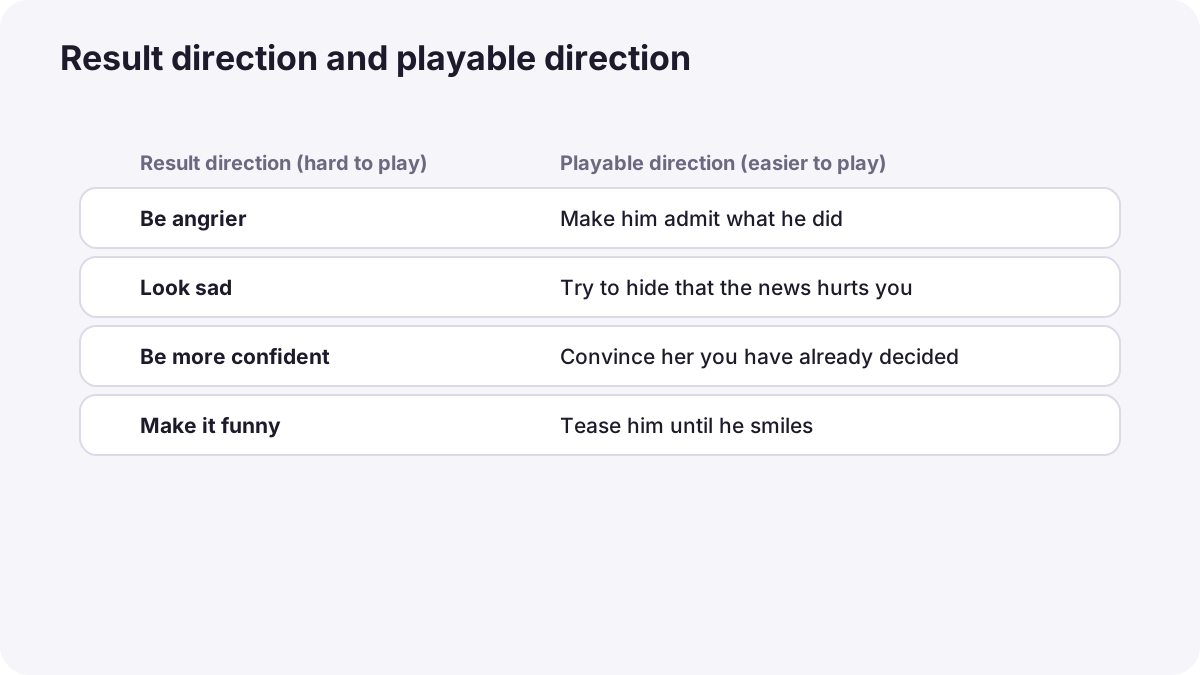
Judith Weston, author of the widely used book Directing Actors (1996), describes result direction as telling performers the effect you want, such as 'be sadder' or 'make it funnier'. It is hard to play and often leads to forced acting. Instead, she recommends playable direction, often using action verbs that describe what the character is trying to do to the other person.
| Result direction (hard to play) | Playable direction (easier to play) |
|---|---|
| Be angrier | Make him admit what he did |
| Look sad | Try to hide that the news hurts you |
| Be more confident | Convince her you have already decided |
| Make it funny | Tease him until he smiles |
Tip:Another useful tool is an 'as if' adjustment: play the scene as if you were telling a secret, or as if you were late for a train.
Giving notes
- Start with what worked so the performer knows what to keep.
- Give one clear note at a time; too many notes overwhelm.
- Speak privately and quietly to performers, not across the whole set.
- Use specific, playable language, not judgments.
- Let them try, then adjust again if needed.
Directing non-actors
- Give tasks, not acting: ask them to make coffee, show you their tools or explain how something works.
- Talk, then roll: a real conversation produces natural speech; keep the camera running.
- Keep scripts short or avoid them: non-actors sound stiff reading lines; use bullet points or questions.
- Film several takes casually so they stop worrying about mistakes.
- Reassure them: remind them that the edit will make them look good.
Interview techniques for non-actors are explained in conducting interviews on camera.
Consistency between takes
Performances must match across takes and angles: the same actions on the same lines, the same props in the same hands. Discuss this with performers, as in continuity and the axis of action. But also allow freedom in some takes; a performer's spontaneous choice can become the best moment of the film.
A respectful, safe set
- Be kind and calm: nervous people perform worse.
- Protect privacy: keep monitors and playback away from people who do not need to see sensitive scenes.
- Agree on physical contact and emotional scenes in advance; respect anyone's limits.
- Take breaks and offer water, especially in long or hot shoots, as in photography safety fundamentals.
- Get proper releases, as in filming people and places.
Common mistakes
- Result direction: 'more emotion' produces forced acting.
- Too many notes at once: performers become confused.
- Criticizing in front of everyone: confidence drops.
- Giving non-actors long scripts: stiff, unnatural delivery.
- Ignoring the performer's comfort: tension shows on camera.
How directors work with performers
Experienced directors build trust before the shoot, discuss characters and intentions, give playable notes privately and one at a time, and protect performers' comfort and safety. With non-actors, they create real situations and conversations and let the camera observe. They watch performances closely on set, because performance matters more to audiences than almost any technical detail.
Practical examples
A forced performance
- Situation
- An actor plays 'be more upset' with exaggerated crying.
- What to do
- You say: 'Try to keep your voice normal so your brother doesn't see how much this hurts.'
- Why it works
- A playable action creates truthful emotion underneath.
- Result
- A restrained, moving performance.
A nervous business owner
- Situation
- A café owner freezes when reading a script to camera.
- What to do
- You put the script away and ask her to show you how she makes her favourite drink while chatting.
- Why it works
- Real tasks and conversation relax non-actors.
- Result
- Warm, natural footage.
Key points
- Directing performance means helping people behave truthfully for the story.
- Avoid result direction; give playable direction with action verbs and 'as if' adjustments.
- Start with what worked, give one clear note privately, and let performers try again.
- Direct non-actors with tasks and real conversation rather than long scripts.
- Keep performances consistent where needed, and keep the set kind, private and safe.
Frequently asked questions
How do I direct actors as a beginner?
What is result direction?
How do I direct people who are not actors?
Should I give notes in front of everyone?
Conclusion
Good performance direction is specific, playable, kind and private, with tasks and conversation for non-actors and care for everyone's comfort. Next, you will learn how to conduct interviews on camera.
Finished reading? Track your progress through Directing and filmmaking.