Behind every film, advert, music video or documentary is someone who decides what the audience should see, hear and feel: the director. The director turns a script or idea into a complete film by guiding performers, crew and editors toward one vision. On big films this is a full-time role surrounded by large teams; on small videos, the same person may direct, film and edit. This lesson explains what a director does at each stage, how they work with key collaborators, how they make decisions, and how to direct even the smallest video with purpose.
The director's job
A director is the person responsible for the creative vision of a film or video and for guiding everyone toward it. They decide how the story is told: what the audience sees in each shot, how performers act, the mood of the images and sound, and the rhythm of the final edit. Planning a production was explained in planning a video production.
Remember:Famous directors are often known for a recognizable style, such as Alfred Hitchcock's careful suspense, Akira Kurosawa's powerful compositions and movement, or Satyajit Ray's quiet, human observation. Each began with a clear idea of what they wanted the audience to feel.
The director at each stage
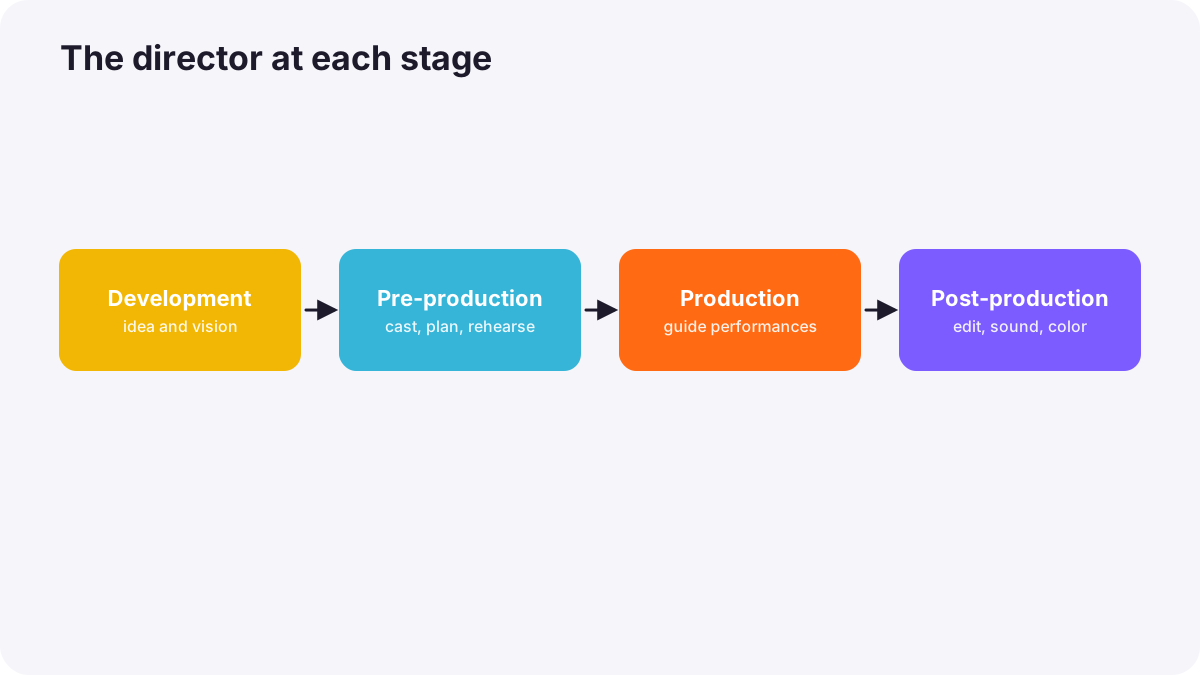
| Stage | Main work |
|---|---|
| Development | Shapes the idea and script, defines the vision and tone |
| Pre-production | Casts performers, chooses locations, plans shots with the cinematographer, rehearses, storyboards |
| Production | Guides performances, approves framing and movement, decides when a take is right |
| Post-production | Works with the editor, sound team and colorist to shape the final film |
Key collaborators
- Writer: the director helps shape the script into something that can be filmed, as in writing a simple script.
- Performers: the director helps them understand characters and give truthful performances, as in directing people on camera.
- Cinematographer (director of photography): together they design the look: lighting, lenses, framing and movement.
- Production designer: creates sets, locations, props and colors.
- Editor, sound team and colorist: shape the film in post-production, as in what video editing is and why it matters.
- Producer: manages money, schedule and logistics so the vision can be made.
Vision and decisions
The director's vision is a clear idea of what the film should feel like and mean. It guides thousands of small decisions: where to put the camera, how fast a scene moves, what color the walls are. A useful exercise is to describe the vision in a few sentences and a set of reference images before filming, as with mood boards in concept development.
- Know the purpose of each scene: what must the audience understand or feel?
- Communicate clearly: explain the why, not just the what.
- Decide and move on: film days are limited; make confident choices.
- Stay open: good ideas can come from anyone on the team.
Directing small productions
On small videos, you may be the director, camera operator and editor at once. Directing still matters: plan what each shot must show, guide the people on camera, protect the story when time runs short, and think about the edit while filming. Even a 30-second social video benefits from someone deciding clearly what it should make viewers feel.
Common mistakes
- No clear vision: every choice is random and the film feels scattered.
- Directing only the camera: performances are left to chance.
- Unclear instructions: crew and performers guess what is wanted.
- Changing plans constantly on set: time runs out and the team loses confidence.
- Ignoring the edit: missing shots make the story impossible to cut.
How directors work
Professional directors prepare deeply: they know the script, the purpose of every scene, and the shots they need. They collaborate closely with the cinematographer, rehearse with performers, communicate calmly and clearly on set, protect the most important moments, and stay involved through the edit, sound and grade until the film matches their vision.
Practical examples
A short brand film
- Situation
- A small team is making a 2-minute film for a bakery.
- What to do
- You write a three-sentence vision about warmth and craftsmanship and share reference images with the team.
- Why it works
- A clear vision guides lighting, shots, performances and music.
- Result
- A consistent, warm film everyone understood.
Running out of time
- Situation
- With one hour left, you still have six shots to film.
- What to do
- You choose the three shots the story cannot work without.
- Why it works
- Directors protect the most important story moments.
- Result
- The film is complete and clear.
Key points
- The director is responsible for the creative vision and guides everyone toward it.
- Directors work in development, pre-production, production and post-production.
- Key collaborators include writers, performers, the cinematographer, designers, editors and producers.
- A clear vision guides thousands of decisions; communicate the why and decide confidently.
- Even small videos need someone to direct purpose, performances and story.
Frequently asked questions
What does a film director do?
What is the difference between a director and a producer?
What is a director's vision?
Do small videos need a director?
Conclusion
Directing means holding the vision and guiding everyone toward it, from script to final grade. Next, you will learn how to structure stories for short videos.
Finished reading? Track your progress through Directing and filmmaking.