Many beginners spend all their money and attention on cameras and lenses, then record sound with whatever microphone is built into the camera. Yet viewers will often watch a slightly soft or noisy picture, but switch off quickly when they cannot understand what people are saying. Sound carries the words, the atmosphere and much of the emotion of a video. This lesson explains why sound is so important, the four main parts of a soundtrack, the difference between sounds inside and outside the story, and who handles sound in a production.
Sound is half the experience
Sound in video means every audio element the viewer hears: voices, background atmosphere, effects and music. Video was introduced as pictures plus sound in photography and videography. Picture shows the viewer where to look; sound tells them how to feel and helps them understand what is happening.
Remember:George Lucas, the creator of Star Wars, has often said that sound is 50 percent of the moviegoing experience. For Star Wars (1977), he hired sound designer Ben Burtt long before filming to create a whole universe of new sounds, from laser blasts to the hum of a lightsaber. Those sounds became as famous as the pictures.
The four parts of a soundtrack
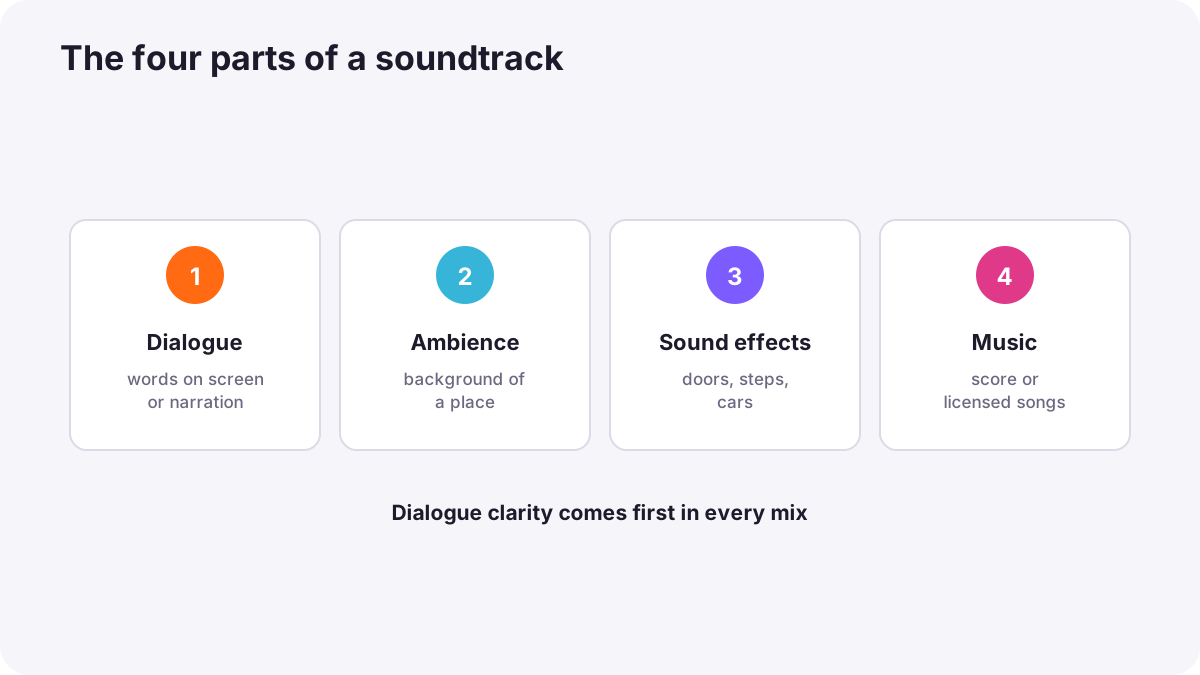
| Element | What it is | What it does |
|---|---|---|
| Dialogue | Words spoken by people on screen or in narration | Tells the story and gives information |
| Ambience | The background sound of a place, such as wind, traffic or birds | Makes the place feel real and continuous |
| Sound effects | Specific sounds, such as footsteps, doors, cars or a camera shutter | Adds realism, impact and detail |
| Music | Songs or score | Sets mood, rhythm and emotion |
Each element is recorded or chosen separately and balanced in the final mix, as explained in basic audio editing and mixing.
Inside and outside the story
- Diegetic sound: sound that exists inside the story, which the characters could hear, such as their conversation, a radio playing in the room or rain on the window.
- Non-diegetic sound: sound added for the audience only, such as background music or a narrator's voice.
Filmmakers sometimes move between the two for effect, for example when music that seemed to be background suddenly turns out to be playing on a character's radio.
Why bad sound loses viewers
- Understanding: if words are unclear, viewers miss the message.
- Effort: listening to noisy or echoing sound is tiring, so people stop watching.
- Trust: poor audio makes even good pictures feel amateur.
- Fixing is hard: noise, echo and distortion are much harder to remove than to avoid.
Tip:A good rule for beginners: spend as much care on the microphone as on the camera. A modest camera with clear sound usually beats an expensive camera with poor sound.
Who handles sound
| Role | Main job |
|---|---|
| Production sound mixer (sound recordist) | Records dialogue and sound on set |
| Boom operator | Holds and aims the boom microphone close to actors |
| Sound designer | Creates the overall sound world and special sounds |
| Dialogue and effects editors | Clean dialogue and add effects |
| Foley artist | Performs everyday sounds, such as footsteps, in a studio to match the picture |
| Re-recording mixer | Balances all elements into the final mix |
On small productions, one person often does several of these jobs. Working with a small crew is explained in working with a small crew.
The basic sound workflow
- Plan sound when scouting and scheduling, as in planning a video production.
- Record clean dialogue with microphones close to the speaker.
- Record room tone and ambience at every location.
- Collect effects and choose licensed music.
- Edit and mix so dialogue is always clear.
- Check the mix on headphones, speakers and a phone.
Common mistakes
- Relying on the camera's built-in microphone: voices sound distant and noisy.
- Never using headphones: problems are discovered only when editing.
- Music louder than voices: viewers cannot follow the words.
- Ignoring background noise when choosing locations: unusable recordings.
- Forgetting ambience: edited scenes sound empty and jumpy.
How professionals treat sound
Professional productions plan sound from the very beginning, hire dedicated sound crews, choose locations with quiet in mind, and protect dialogue above everything else. In post-production, specialist editors and mixers build rich soundtracks of dialogue, ambience, effects and music, and test the final mix on many kinds of speakers.
Practical examples
A beautiful video nobody finished
- Situation
- Your travel video looks great, but viewers leave in the first minute.
- What to do
- You re-record the narration with a close microphone in a quiet room and lower the music.
- Why it works
- Clear dialogue keeps viewers watching; loud music hid the words.
- Result
- People watch much longer.
An empty-sounding edit
- Situation
- An edited café scene feels strange and silent between lines.
- What to do
- You add the café ambience you recorded on location under the whole scene.
- Why it works
- Continuous ambience makes the place feel real and hides cuts.
- Result
- The scene sounds natural and smooth.
Key points
- Sound carries words, atmosphere and emotion; George Lucas called it 50 percent of the moviegoing experience.
- A soundtrack has four parts: dialogue, ambience, sound effects and music.
- Diegetic sound exists in the story; non-diegetic sound, like score and narration, is for the audience.
- Viewers forgive average pictures more easily than unclear sound.
- Plan sound from the start, record clean dialogue and ambience, and keep dialogue clear in the mix.
Frequently asked questions
Why is sound important in video?
What are the elements of film sound?
What is diegetic sound?
What is Foley?
Conclusion
Sound is half of video: dialogue, ambience, effects and music together create understanding and emotion. Treat the microphone as seriously as the camera. Next, you will learn how sound itself works: waves, levels and decibels.
Finished reading? Track your progress through Sound for video.