Editing is where a video is really made. The editor takes hours of footage, chooses the best moments, puts them in order and decides how long each one lasts. The same footage can become a moving story or a confusing mess depending on these choices. Many film editors describe editing as the final rewrite of the script. This lesson explains what video editing is, what an editor is trying to achieve, the stages of an edit from first assembly to finished film, and the famous principles editors use to judge a cut.
What video editing is
Video editing is selecting, arranging and timing shots and sounds to tell a story or communicate a message. It includes choosing the best takes, cutting out unwanted parts, ordering shots and scenes, setting the rhythm, and combining picture with dialogue, music and effects. How shots, scenes and sequences create meaning was explained in visual storytelling in film.
Photographers edit too, choosing and sequencing images, as in editing and sequencing a body of work. Video editing adds time: each decision also controls how long the viewer looks and listens.
What an editor is trying to achieve
- Clarity: viewers always understand what is happening and where.
- Emotion: viewers feel what the story needs them to feel.
- Rhythm: the video moves at the right pace, as in pacing and rhythm.
- Continuity: shots flow smoothly unless a jump is intended, as in continuity and the axis of action.
- Economy: every shot earns its place; anything that does not help is removed.
Walter Murch's rule of six
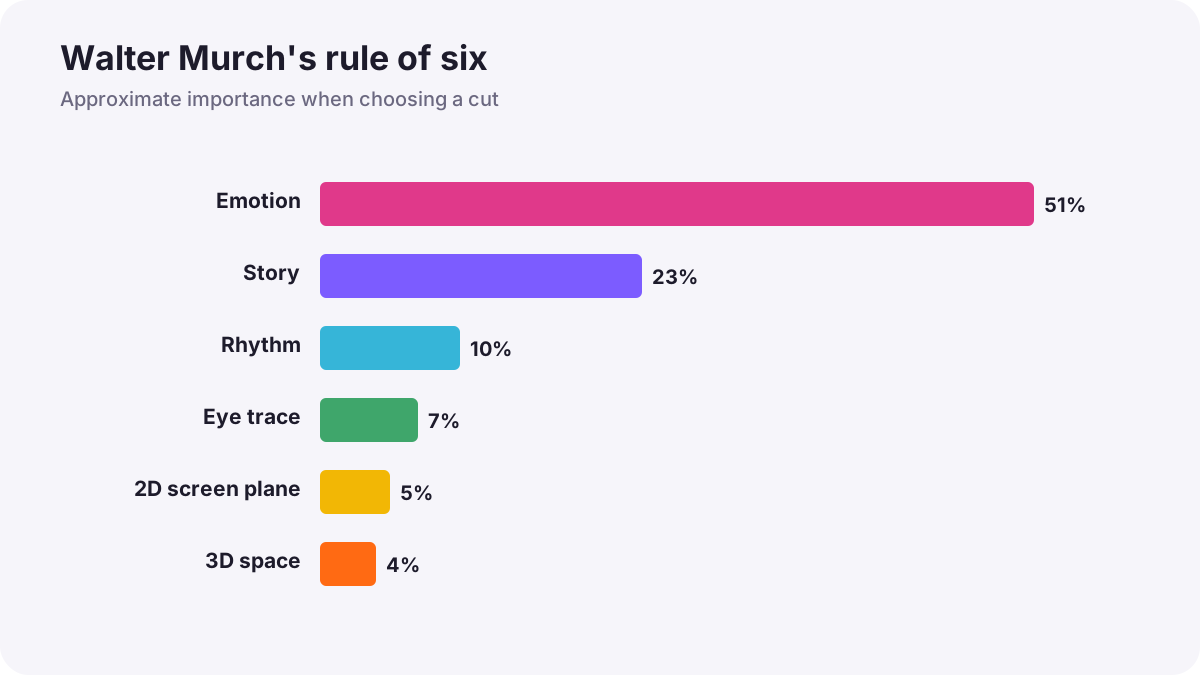
Walter Murch, the editor of films such as Apocalypse Now and The English Patient, described six things to consider when choosing where to cut, in his book In the Blink of an Eye. He gave them rough importance values to show their priority:
| Priority | Criterion | Question it asks |
|---|---|---|
| 1 | Emotion (about 51%) | Does the cut feel right emotionally? |
| 2 | Story (about 23%) | Does it move the story forward? |
| 3 | Rhythm (about 10%) | Does it happen at the right moment in time? |
| 4 | Eye trace (about 7%) | Will the viewer's eye find the right place in the new shot? |
| 5 | Two-dimensional screen plane (about 5%) | Are directions and screen positions consistent? |
| 6 | Three-dimensional space (about 4%) | Is the physical space of the scene believable? |
Tip:The lesson is simple: if you must choose, protect emotion and story first. A cut that feels emotionally right is usually better than one that is only technically perfect.
The stages of an edit
| Stage | What happens |
|---|---|
| Organizing and logging | Footage is sorted, synced and labeled, as in organizing footage and setting up a project |
| Assembly | All usable shots are placed roughly in story order |
| Rough cut | The story structure takes shape, as in building the rough cut |
| Fine cut | Timing, pacing and details are refined |
| Picture lock | The picture edit is final; no more changes to shots or timing |
| Finishing | Sound mixing, color grading, titles, then export, as in reviewing and finishing an edit |
Picture lock matters because sound mixing and color grading are done to the exact timing of the edit. Changing the edit afterward means redoing that work.
The editor's role
On larger productions, the editor works with the director, often for weeks or months, while assistant editors organize footage and sync sound. On small projects, the same person often films, edits, mixes and grades. Either way, the editor is the first true audience: they must watch the footage with fresh eyes and decide what really works, even if it was difficult or expensive to film.
Common mistakes
- Keeping shots because they were hard to get: the video becomes long and slow.
- Polishing before the structure works: time is wasted on scenes that may be cut.
- Too many effects and transitions: viewers notice the editing instead of the story.
- Ignoring sound while editing: the edit feels wrong even with good pictures.
- Changing the edit after picture lock: sound and color must be redone.
How professional editors work
Professional editors watch all the footage, organize it carefully, build structure before detail, and judge cuts mainly by emotion and story. They show cuts to others for fresh reactions, remove anything that does not serve the video, and lock picture before sound and color finishing begins.
Practical examples
A long wedding highlight
- Situation
- Your first highlight film is 12 minutes and feels slow.
- What to do
- You remove every shot that does not add emotion or story and keep only the strongest moments.
- Why it works
- Economy and emotion matter more than including everything.
- Result
- A 4-minute film the couple watches again and again.
A technically perfect but flat cut
- Situation
- Your interview edit has perfect continuity but feels lifeless.
- What to do
- You re-cut it around the speaker's most emotional moments and reactions.
- Why it works
- Murch's rule of six puts emotion first.
- Result
- An engaging, human interview.
Key points
- Video editing is selecting, arranging and timing shots and sounds to tell a story.
- Editors aim for clarity, emotion, rhythm, continuity and economy.
- Walter Murch's rule of six puts emotion and story above technical continuity.
- Edits move through assembly, rough cut, fine cut, picture lock and finishing.
- Lock the picture before sound mixing and color grading.
Frequently asked questions
What is video editing?
What is the rule of six in editing?
What is picture lock?
What is the difference between a rough cut and a fine cut?
Conclusion
Editing shapes footage into a story: choosing, ordering and timing shots with emotion and story first, moving from assembly to picture lock before finishing. Next, you will learn the editing software and the timeline where all of this happens.
Finished reading? Track your progress through Video editing.