The rough cut is the first version of the edit that tells the whole story from beginning to end. It is not polished: cuts may be clumsy, there may be no music or color, and it is usually too long. Its job is to answer the most important question early: does the story work? Editors who try to perfect every shot before the structure is right waste days on scenes that later disappear. This lesson explains the difference between an assembly and a rough cut, how to plan with a paper edit, how to choose takes, how to find structure, and how to get useful feedback.
Assembly and rough cut
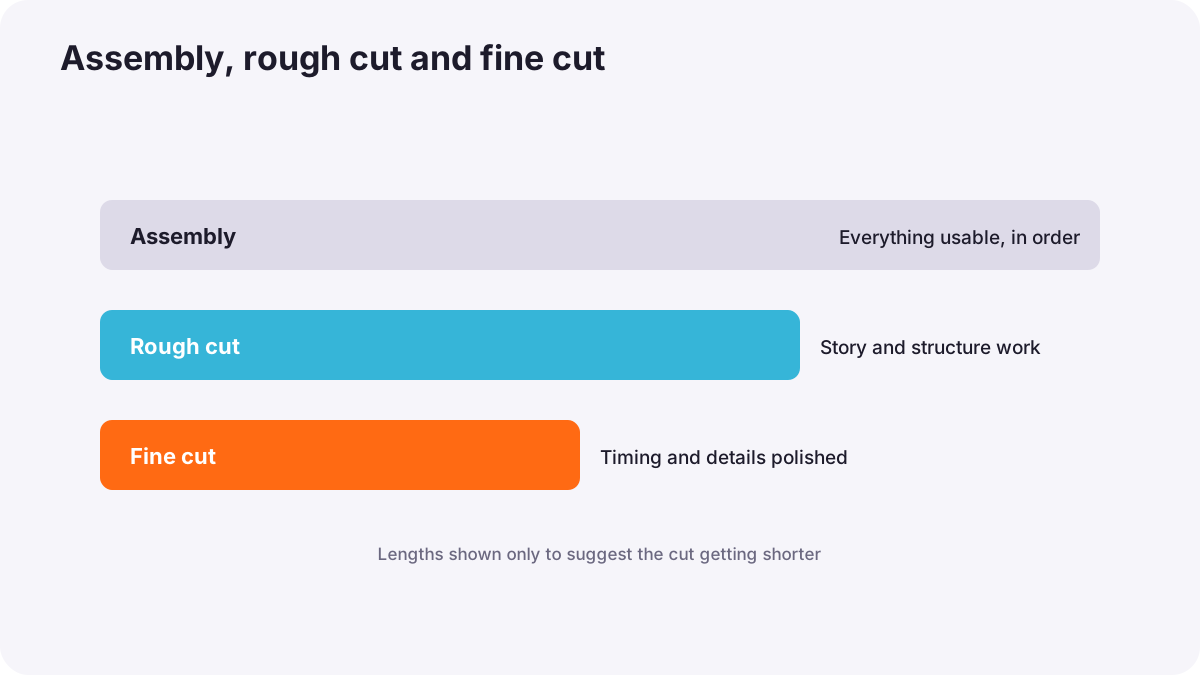
| Assembly | Rough cut | |
|---|---|---|
| What it contains | All usable shots roughly in script or story order | The chosen takes and scenes that tell the story |
| Length | Very long | Usually still longer than the final video |
| Purpose | See all the material together | Test the story and structure |
| Polish | None | Very little; structure matters most |
The stages of an edit were introduced in what video editing is and why it matters, and organizing footage and selects in organizing footage and setting up a project.
The paper edit
A paper edit is a written plan of the edit before you touch the timeline. For interviews and documentaries, you read the transcripts, highlight the strongest quotes, and arrange them in order on paper or in a document. For scripted work, you follow the script and storyboard, as in storyboards and shot planning. A paper edit helps you see the whole story at once.
Building the rough cut
- Start from your selects and paper edit.
- Lay down the spine: the main story line, such as the interview answers, narration or key scenes.
- Choose the best takes for performance and emotion first, technical quality second, as in Murch's rule of six.
- Add the essential B-roll and cutaways only where needed to understand the story, as in B-roll and cutaways.
- Watch the whole cut from start to end without stopping.
- Note what is confusing, slow or missing, then rearrange.
Tip:Work in large blocks first. Moving whole scenes or sections changes a story far more than trimming single frames.
Finding the structure
- Beginning: hook the viewer and set up the question or situation, as in story structure for short videos.
- Middle: develop the story, with changes, challenges or discoveries.
- End: resolve the question and leave a clear feeling or message.
- Documentaries: the story is often found in the edit, so try several structures.
- Short videos: start with the strongest moment, as in short-form vertical video for social media.
Temporary music and sound
A rough music track can help you feel rhythm and emotion, but be careful: the final music may be different, and clients can become attached to temporary tracks they cannot afford to license, as in music licensing for video. Keep dialogue levels roughly even so viewers can judge the story.
Getting feedback
- Explain what stage it is: tell viewers it is a rough cut, so they focus on story, not color or sound.
- Ask specific questions: Where did you get bored? What was unclear? What did you feel?
- Watch the viewers: notice when they look away or reach for their phones.
- Separate feedback from solutions: viewers are good at finding problems; the editor finds the best fix.
Client revision rounds were explained in client expectations and revisions.
Common mistakes
- Polishing too early: time spent on scenes that will be removed.
- Never watching the whole cut in one go: structure problems are missed.
- Keeping every good shot: the rough cut never becomes shorter.
- Falling in love with temporary music: disappointment when it cannot be used.
- Asking for vague feedback: comments are not useful.
How editors build rough cuts
Professional editors build the story spine from selects and paper edits, choose takes for emotion, watch full cuts repeatedly, and move large sections before refining details. Documentary editors try several structures and often find the story only in the edit. They show rough cuts to trusted viewers and directors early, then move to the fine cut once the structure works.
Practical examples
A business story
- Situation
- Your first cut of a company film follows the order things were filmed and feels confusing.
- What to do
- You make a paper edit of the best interview quotes and rearrange the cut around a clear beginning, middle and end.
- Why it works
- Structure built from the story is clearer than filming order.
- Result
- A rough cut that makes sense from start to finish.
A rough cut viewers found slow
- Situation
- Test viewers lost interest in the middle of your documentary.
- What to do
- You remove a whole section that repeated an earlier point.
- Why it works
- Large structural changes fix pacing more than trimming frames.
- Result
- A tighter, more engaging story.
Key points
- An assembly gathers all usable shots; a rough cut tests the story and structure.
- Plan with a paper edit of the strongest quotes or the script.
- Build the story spine first and choose takes for emotion and performance.
- Work in large blocks, watch the whole cut and fix structure before polish.
- Get specific feedback, and be careful with temporary music.
Frequently asked questions
What is a rough cut?
What is a paper edit?
How long should a rough cut be?
What feedback should I ask for on a rough cut?
Conclusion
A good rough cut gets the story right before anything is polished: plan with a paper edit, build the spine, choose takes for emotion, fix structure in large blocks and test with viewers. Next, you will learn the types of cuts and transitions used to join shots.
Finished reading? Track your progress through Video editing.