Creative employers usually want to see you work, not just hear you talk. After a first conversation, many ask for a test shoot, an editing or retouching test, or a practical day on set. This lesson shows how to prepare, how to talk about your portfolio clearly, which questions to expect, how to approach practical tests and how to follow up professionally.
Before the interview
- Study the company's work and recent projects.
- Re-read the job description and match your examples to it.
- Prepare three short stories about projects: the challenge, what you did and the result.
- Prepare your portfolio on a reliable device, ready to show offline.
- Prepare two questions about the team, workflow or projects.
Common questions
| Question | What they want to know |
|---|---|
| Talk me through this project. | Your role, process and decisions |
| What went wrong on a shoot, and what did you do? | Problem solving and calm |
| Which software and equipment do you use? | Technical fit |
| How do you handle feedback or changes? | Teamwork and attitude |
| Why do you want to work here? | Interest and research |
Tip:Talking about your work clearly uses the critique skills from how to critique a photograph: describe, explain choices and results.
Test shoots and skills tests
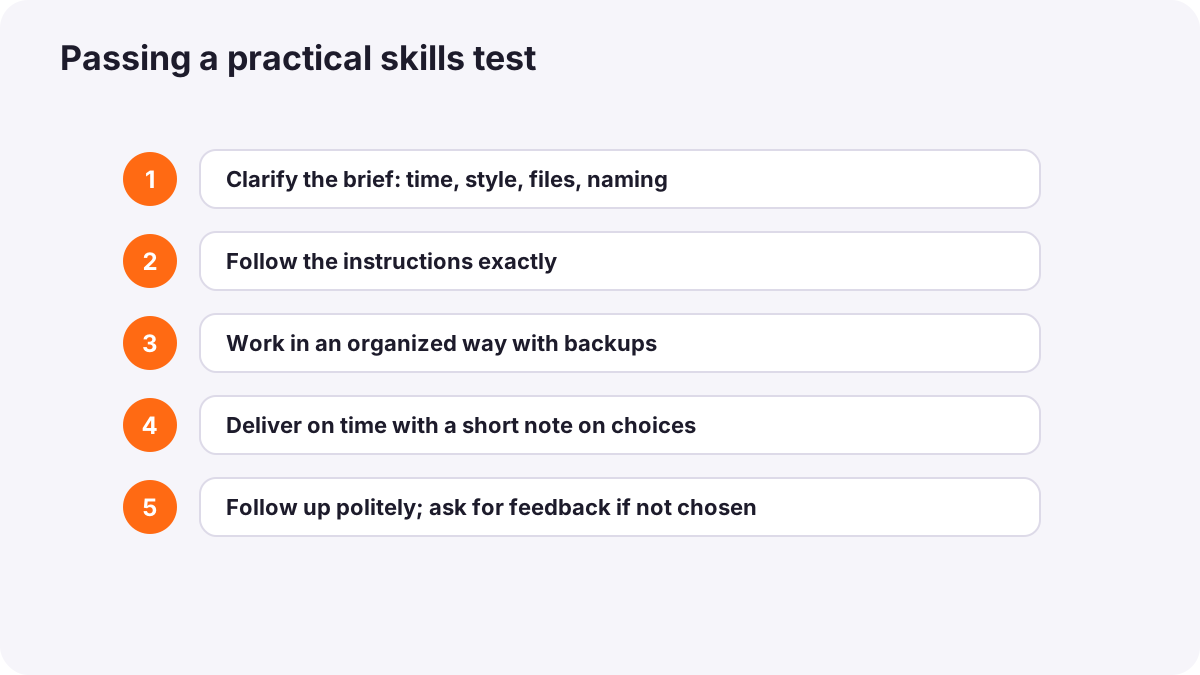
- Clarify the brief: time limit, style, files to deliver and naming.
- Follow instructions exactly; following the brief is part of the test.
- Show your workflow: organized files, backups and clean delivery.
- Deliver on time with a short note explaining your choices.
- Keep it fair: a long or unpaid test that looks like real client work is a warning sign.
After the interview
Send a short thank-you message within a day, mentioning something specific from the conversation. If you are not chosen, ask politely for feedback and stay in touch; creative industries are small, and the next opening may come from the same people.
Common mistakes
- Showing too much work: keep to your best and most relevant.
- Not knowing your role on a project: lost credibility.
- Ignoring test instructions: shows you may ignore client briefs.
- Speaking badly about past employers or clients: a red flag.
How strong candidates stand out
Strong candidates research the company, show a short relevant portfolio, explain decisions clearly, follow test briefs exactly, deliver organized files on time and follow up politely.
Practical examples
A retouching test
- Situation
- A studio sends five product images to retouch in two hours.
- What to do
- You follow their style notes, name files as asked and add a short note on your steps.
- Why it works
- Following instructions and clear delivery matter as much as quality.
- Result
- You are offered the job.
A difficult question
- Situation
- You are asked about a shoot that went wrong.
- What to do
- You explain a failed light, how you switched to window light, and the client's happy result.
- Why it works
- A calm, specific story shows problem solving.
- Result
- A strong impression.
Key points
- Research the company and prepare three project stories and two questions.
- Expect questions about your role, problem solving, tools, feedback and motivation.
- In practical tests, follow the brief exactly and deliver organized files on time.
- Follow up with thanks, ask for feedback if not chosen and stay in touch.
Frequently asked questions
What is a test shoot for a job?
How do I talk about my portfolio?
Are unpaid tests normal?
Should I follow up after an interview?
Conclusion
Preparation, clear stories and careful tests turn interviews into offers. Next, you will learn how to succeed in your first job and grow your career.
Finished reading? Track your progress through Freelancing and careers.