The hardest client to win is the first one. Without paid work it is hard to build a portfolio, and without a portfolio it is hard to get paid work. This lesson shows practical ways to break that circle: practice projects that look like real work, assisting experienced professionals, letting the right people know you are available, choosing small first clients and collecting testimonials that open the next doors.
Build proof before the first job
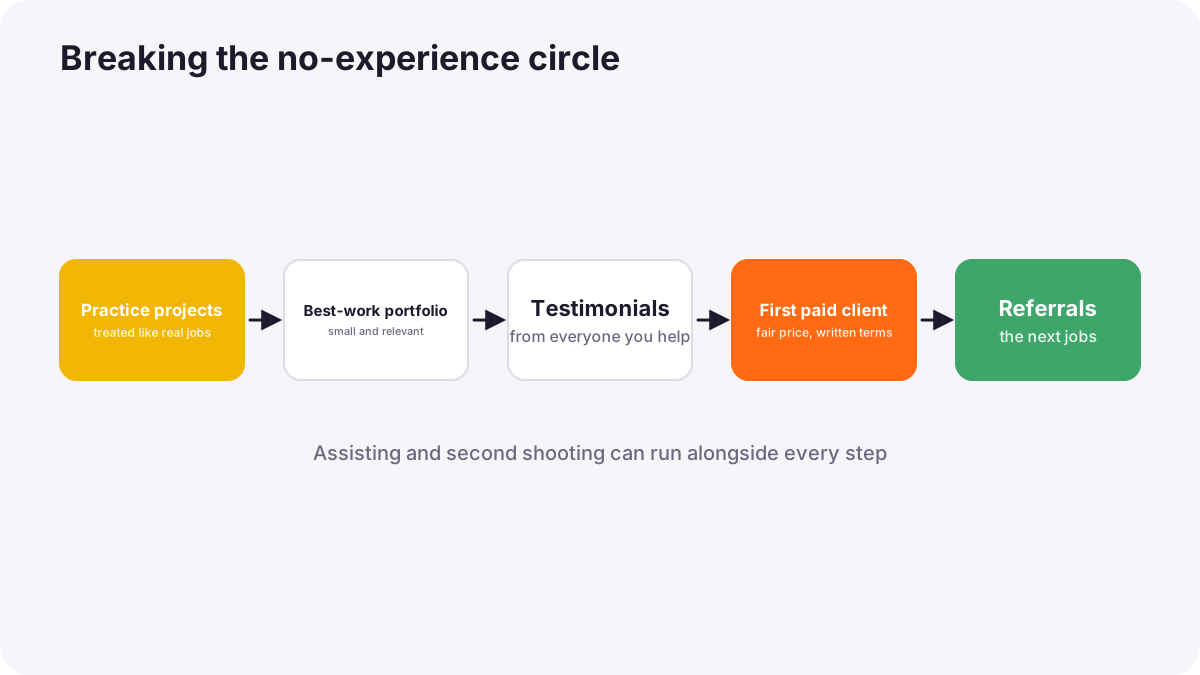
- Create practice projects that match the work you want: a product set for a friend's shop, a short promo for a local club.
- Treat them like real jobs: a brief, a deadline and a proper delivery.
- Select only your best results for your portfolio, as in building a professional photography portfolio.
- Ask for a short testimonial from each person you help.
Ways to find first clients
| Route | How |
|---|---|
| People you know | Tell friends, family and contacts exactly what you offer |
| Local businesses | Show two or three examples that fit their business |
| Assisting and second shooting | Work with an established professional |
| Community and events | Clubs, schools, charities and small events |
| Online platforms | Freelance marketplaces, as in the next lesson |
| Your content | Helpful posts that show your skill, as in earning money as a creator |
Remember:Finding clients is covered in depth in finding clients and building relationships.
Free, discounted or paid?
A few practice or portfolio projects can be free or low-cost when they truly build your skills and portfolio. After that, charge a fair price, even if it is modest, because paying clients value the work, communicate more clearly and treat you as a professional. Pricing is explained in building packages and raising your rates.
Common mistakes
- Waiting for the perfect portfolio: start with a small, honest set.
- Saying yes to every job: work you cannot deliver well hurts your reputation.
- Working for free indefinitely: clients learn not to pay.
- No written agreement even for small jobs: misunderstandings, as in contracts and client communication.
How professionals started
Most professionals began with small jobs, assisting and practice projects, delivered each one carefully, collected testimonials and referrals, and raised their prices step by step as demand grew.
Practical examples
A first product client
- Situation
- You want product work but have no clients.
- What to do
- You photograph a friend's handmade soaps for free, then show the results to three local shops.
- Why it works
- A relevant example proves you can do the job.
- Result
- One shop books a paid shoot.
Second shooting
- Situation
- You want to film weddings.
- What to do
- You offer to film B-roll for an established wedding videographer.
- Why it works
- You learn on real jobs while building footage.
- Result
- Paid work and a referral network.
Key points
- Build proof with practice projects treated like real jobs.
- Find first clients through people you know, local businesses, assisting, community events, platforms and your content.
- Do only a few free portfolio projects, then charge a fair price.
- Use written agreements and collect testimonials from the start.
Frequently asked questions
How do I get my first photography client?
Should I work for free to build a portfolio?
What should my first portfolio include?
Do I need a contract for small jobs?
Conclusion
Small, well-delivered jobs open the door to bigger ones. Next, you will learn how freelance marketplaces work and how to use them safely.
Finished reading? Track your progress through Freelancing and careers.