There is more than one way to earn a living with a camera. Some people freelance for many clients, some build a business with a brand and a team, and some work for studios, agencies or production companies. Many combine paths over a career. This lesson compares the three main routes so you can choose a starting point that fits your skills, personality and situation, and plan how you might move between them.
The three main paths
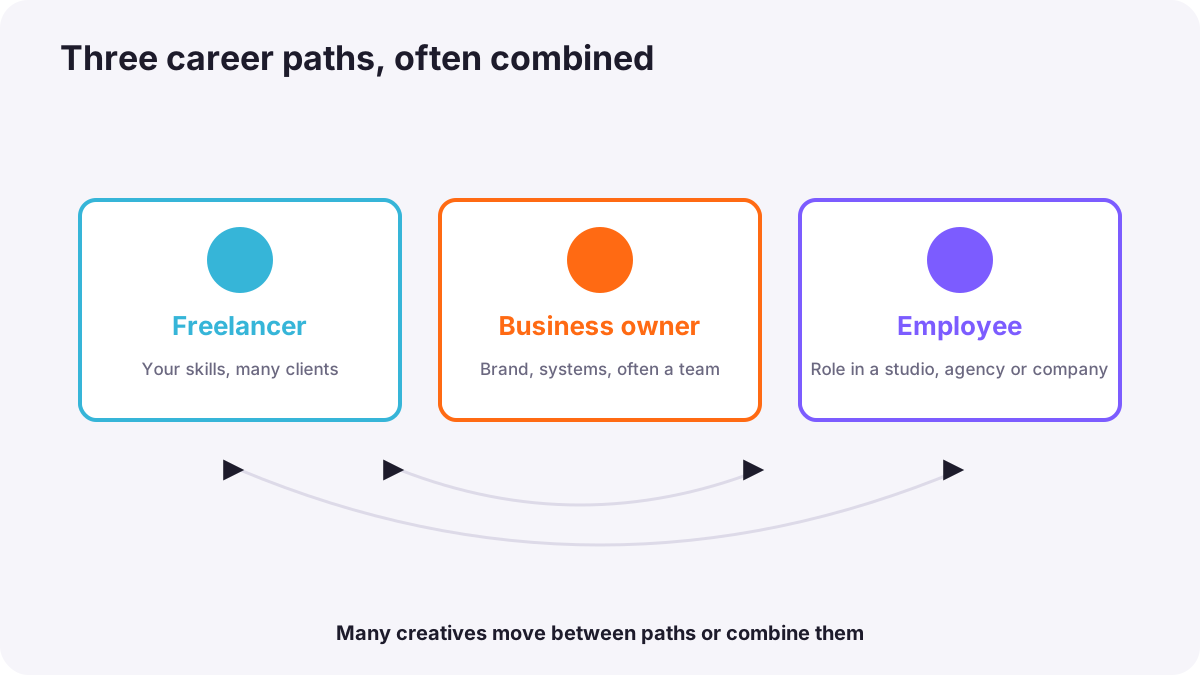
| Freelancer | Business owner | Employee | |
|---|---|---|---|
| What you do | Sell your own skills to many clients | Build a brand, services and often a team | Work for a studio, agency or company |
| Income | Varies month to month | Varies; can grow beyond your own time | Regular salary |
| Freedom | High | High, with more responsibility | Lower; set tasks and hours |
| You handle | Clients, pricing, admin | Everything, plus staff and growth | Your role; the company handles clients |
| Learning | Learn by doing many jobs | Learn business and leadership | Learn from experienced colleagues |
Hybrid paths are common
Many creatives combine paths: a staff editor who freelances on weekends, a freelancer who also runs a content channel, or a business owner who teaches. Starting as an employee or assistant often builds skills and contacts before freelancing. The wider picture of photography careers is explained in building a photography career.
Choosing your starting point
- Be honest about your skills: can you deliver reliable results without supervision yet?
- Consider your money needs: can you handle months with low income?
- Think about how you like to work: alone, in a team, with variety or with routine.
- Look at your local market: which clients and companies exist near you or online.
- Choose a first step, not a forever decision.
Remember:Young learners can start building skills, a portfolio and small projects now, with a parent or guardian involved in any paid work.
Common mistakes
- Quitting a stable income too early: pressure to accept bad jobs.
- Thinking freelancing means only creative work: admin and sales take real time.
- Seeing employment as failure: it is a strong way to learn and earn.
- Never planning the next step: careers drift.
How professionals plan careers
Successful creatives choose paths deliberately, review them every year, build skills and savings before big changes, and keep relationships strong whichever path they follow.
Practical examples
From assistant to freelancer
- Situation
- You want to shoot weddings but have no experience.
- What to do
- You work as a second shooter for an established photographer for two seasons.
- Why it works
- You learn real workflows and build a portfolio while paid.
- Result
- You launch your own freelance service with confidence.
Staff editor plus freelance
- Situation
- You enjoy a steady job but want creative variety.
- What to do
- You keep your agency job and take a few freelance color jobs, avoiding conflicts with your employer.
- Why it works
- A hybrid path adds income and experience with less risk.
- Result
- Extra income and a growing reputation.
Key points
- Freelancers sell their skills to many clients; business owners build brands and teams; employees work within companies.
- Each path differs in income stability, freedom, responsibilities and learning.
- Hybrid paths are common and often the safest start.
- Choose a first step based on skills, money needs, working style and market.
Frequently asked questions
Is it better to freelance or get a job?
Can I freelance while employed?
What is the difference between a freelancer and a business owner?
Can teenagers start a photography career?
Conclusion
Choose a path as a starting point, not a final destination. Next, you will look at which services pay and where the work is.
Finished reading? Track your progress through Freelancing and careers.