Studios, advertising agencies, production companies, media houses and brands all employ people with photography and video skills. Job titles can be confusing, and many roles never appear in film credits or photo bylines. This lesson maps the main workplaces and jobs, from entry roles to senior positions, so you can see where your skills fit and plan a path upward.
Where creative people work
| Employer | What they make |
|---|---|
| Photo studios | Portraits, products, e-commerce, catalogues |
| Advertising and creative agencies | Campaigns, social content, brand films |
| Production companies | Commercials, films, music videos, corporate video |
| Post-production houses | Editing, color, sound, visual effects |
| Media and news organizations | News photos, documentaries, online video |
| Brands with in-house teams | Their own product and social content |
| Rental houses and camera shops | Equipment, support and advice |
Common roles from entry to senior
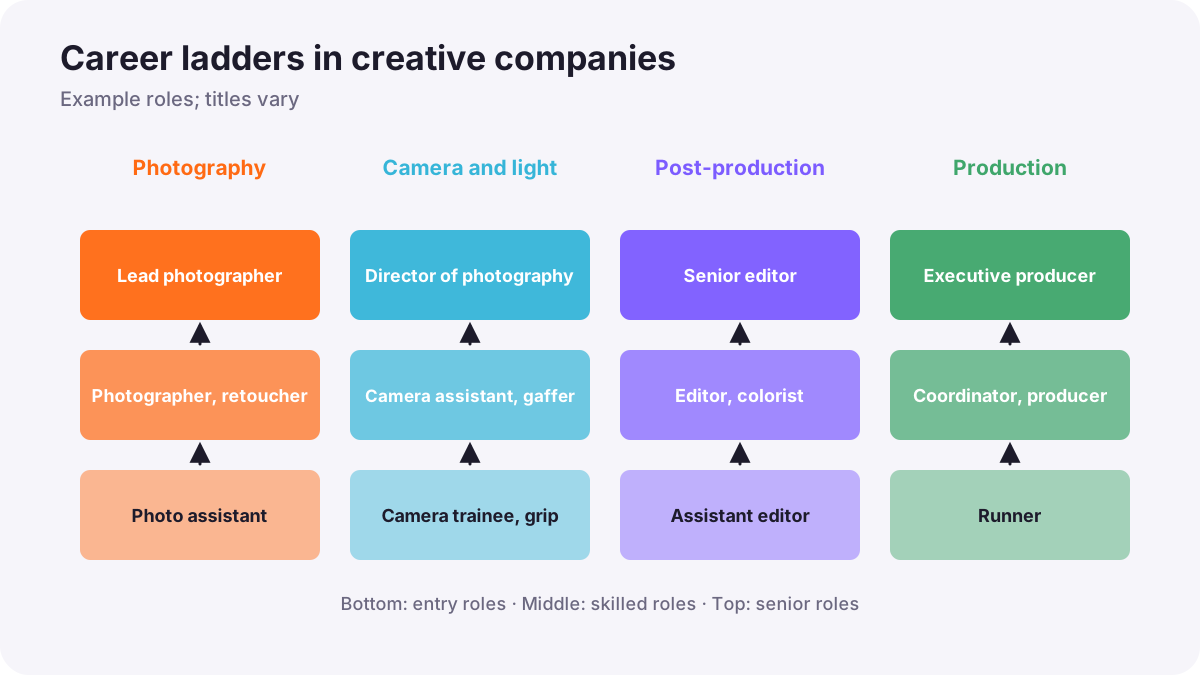
| Area | Entry roles | Skilled roles | Senior roles |
|---|---|---|---|
| Photography | Studio or photo assistant | Photographer, digital tech, retoucher | Lead photographer, photo director |
| Camera and light | Camera trainee, grip, electrician | Camera assistant, gaffer, camera operator | Director of photography |
| Post-production | Assistant editor, data wrangler | Editor, colorist, sound editor | Senior editor, supervising colorist |
| Production | Runner / production assistant | Production coordinator, producer | Executive producer |
| Creative | Junior content creator | Art director, content producer | Creative director |
Remember:Crew roles on set are introduced in working with a small crew. Titles vary between countries and companies.
Skills employers look for
- Reliable technical skill in your area.
- Speed and organization: files, schedules and checklists.
- Communication and teamwork: taking direction and asking clear questions.
- Professional attitude: punctual, calm and respectful, as in professional conduct.
- Willingness to learn new tools and workflows.
Common mistakes
- Applying only for senior creative roles: entry roles are the usual door.
- Ignoring post-production and technical jobs: many steady careers are there.
- Not researching the company's work: weak applications.
How people build careers in companies
People who grow in creative companies start in entry roles, learn from senior colleagues, become known for reliability, take on more responsibility and move up or specialize. Many later freelance in the same roles with the contacts they built.
Practical examples
From runner to editor
- Situation
- You want to edit films but have no industry contacts.
- What to do
- You take a runner job at a production company and help in the edit suite when possible.
- Why it works
- Entry roles give access to people and real projects.
- Result
- You become an assistant editor.
An in-house role
- Situation
- You enjoy product photography and want steady income.
- What to do
- You apply to a brand's in-house content team with a product-focused portfolio.
- Why it works
- In-house teams need consistent product images and video.
- Result
- A salaried creative job.
Key points
- Studios, agencies, production companies, post houses, media, in-house brand teams and rental houses employ creatives.
- Careers follow ladders from entry roles to skilled and senior roles.
- Employers value reliable skill, organization, communication, professionalism and learning.
- Entry and technical roles are common, valuable starting points.
Frequently asked questions
What jobs can I get with photography skills?
What jobs exist in video production?
Do I need a degree to work at a studio or agency?
What is a runner?
Conclusion
Many creative careers start in companies and grow through skill and reliability. Next, you will learn the entry routes: assisting, internships and runner jobs.
Finished reading? Track your progress through Freelancing and careers.