Most photographers and filmmakers learned their craft on real jobs before running them. Assisting, internships and runner jobs put you next to experienced professionals, where you learn workflows, equipment and set behavior that no course can fully teach. This lesson explains these entry routes, how to find them, what you will actually do and how to make the kind of impression that leads to the next job.
The main entry routes
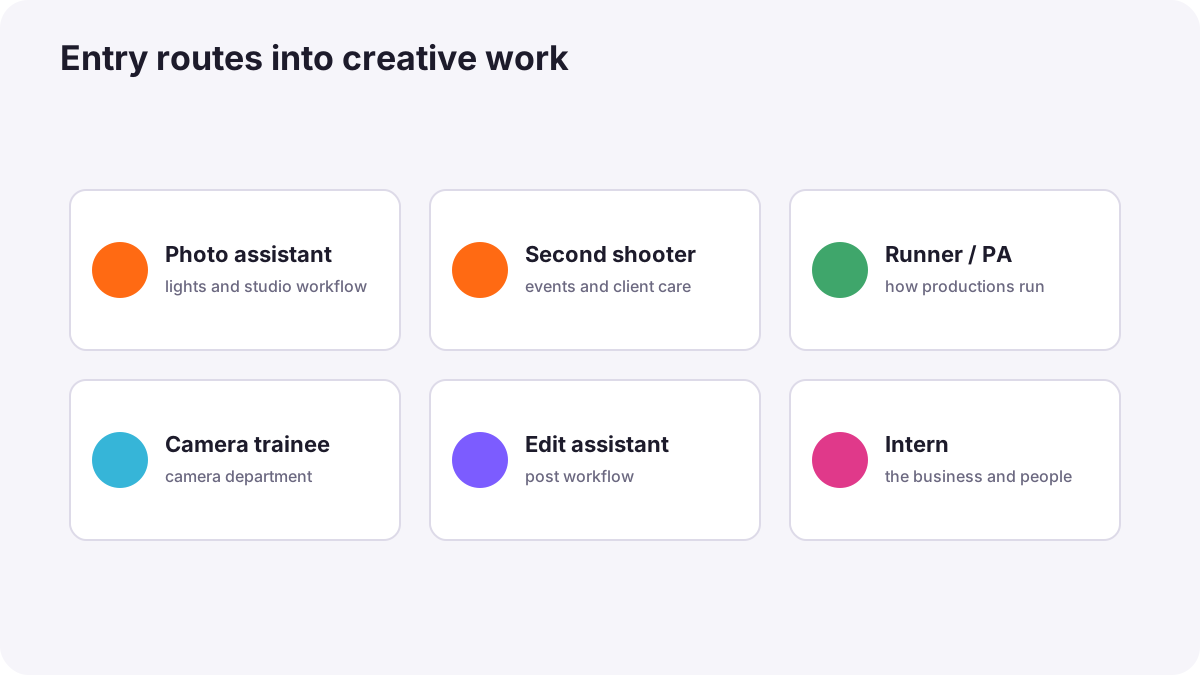
| Role | What you do | What you learn |
|---|---|---|
| Photo assistant | Lights, gear, tethering, files | Lighting and studio workflow |
| Second shooter | Extra coverage at events | Event timing and client care |
| Runner / production assistant | Errands, logistics, set support | How productions run |
| Camera trainee | Batteries, cards, labels, cleaning | Camera department skills |
| Edit assistant | Organizing, syncing, exports | Post-production workflow |
| Intern | Varied tasks within a company | The business and its people |
Remember:Internship rules and pay differ by country. Learn what is legal where you live, and be careful with long unpaid roles.
Finding entry roles
- List local studios, agencies and production companies and study their work.
- Send short, personal messages offering specific help with a link to your work.
- Use job boards and crew groups for film and photo work.
- Ask your network and attend creative events, as in networking and collaboration.
- Follow up politely after a few weeks.
Making a great impression
- Arrive early, prepared and dressed for practical work.
- Listen, then ask short, useful questions at the right moment.
- Anticipate needs: the next battery, the next light, clean cables.
- Follow set etiquette, as in working with a small crew.
- Keep confidentiality: do not post client work without permission.
- Say thank you and stay in touch.
Tip:Many first jobs come from assistants recommending each other. Being reliable and pleasant matters as much as skill.
Common mistakes
- Pitching your own portfolio to the client on set: it undermines the person who hired you.
- Phone use on set: distraction and possible confidentiality breaches.
- Pretending to know equipment you do not: mistakes on expensive gear.
- Disappearing after the job: missed future work.
How assistants become leaders
Assistants who move up learn every role around them, become known for reliability, keep good relationships, build their own portfolios on the side and take on more responsibility step by step.
Practical examples
A studio assistant
- Situation
- You want to learn studio lighting.
- What to do
- You offer to assist a product photographer one day a week.
- Why it works
- You learn by watching and helping on real shoots.
- Result
- You master professional lighting and get referred for paid assisting.
A runner's reputation
- Situation
- You are a runner on a commercial shoot.
- What to do
- You arrive early, anticipate needs and keep the set tidy.
- Why it works
- Reliability gets noticed by producers.
- Result
- You are booked again and introduced to the camera team.
Key points
- Assisting, second shooting, runner jobs, camera trainee, edit assistant and internships are common entry routes.
- Find roles by researching companies, sending personal messages, using job boards and networking.
- Make an impression with punctuality, preparation, anticipation, etiquette and confidentiality.
- Never pitch yourself to the client on someone else's job.
Frequently asked questions
How do I become a photography assistant?
What does a runner do?
Are unpaid internships worth it?
What should I not do on set?
Conclusion
Entry roles put you next to experienced professionals and real work. Next, you will prepare a CV, profile and job-ready portfolio.
Finished reading? Track your progress through Freelancing and careers.