When studios, agencies and production companies hire, they look quickly at three things: your work, your experience and whether you seem reliable. A clear CV, a professional online profile and a portfolio tailored to the job answer those questions in seconds. This lesson shows what to include in each, how to show credits and responsibilities honestly, and how to write a short message that gets opened.
A one-page creative CV
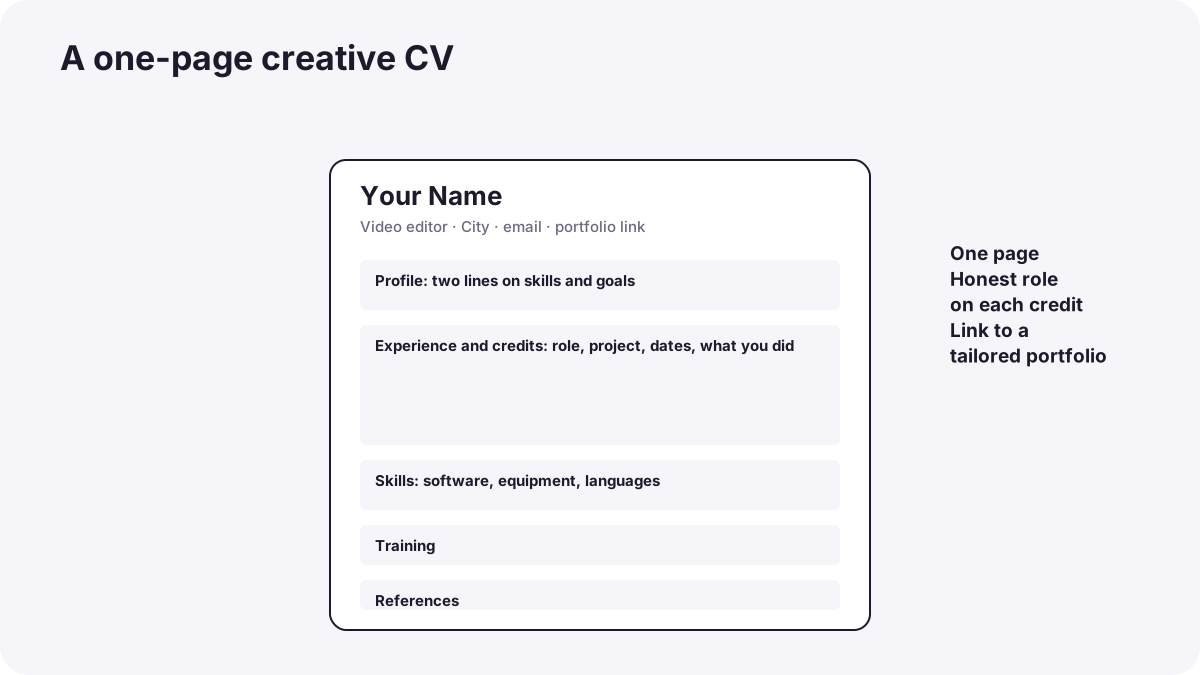
| Section | Contents |
|---|---|
| Header | Name, role, city, email, portfolio link |
| Short profile | Two lines on your skills and the work you want |
| Experience and credits | Role, project or company, dates, what you did |
| Skills | Software, equipment, languages |
| Education and training | Including courses and certificates |
| References | Available on request, or one or two names |
Remember:Be exact about your role: "assistant editor" or "second shooter" is honest and respected. Exaggerated credits are quickly discovered.
Your online profile
Keep a professional profile on a career network and your own website with the same name, photo and summary. List your role, best projects, skills and contact details. Your website structure and brand are explained in photography website structure and personal brand and professional identity.
Tailor your portfolio to the job
- Show work that matches the role: product images for a product studio, edits for an editing job.
- Lead with your strongest pieces, as in portfolio structure and presentation.
- For video roles, send a short showreel plus one or two complete projects, as in building a showreel.
- Explain your role on each project in one line.
A short application message
- Name the role and why this company interests you.
- Give two or three relevant strengths with proof.
- Link your tailored portfolio.
- Thank them and say when you are available.
Common mistakes
- Long CVs full of unrelated jobs: the key information is lost.
- Sending the same portfolio to every employer: weak matches.
- Broken or private portfolio links: instant rejection.
- Exaggerating credits: lost trust in a small industry.
How professionals present themselves
Working professionals keep a short, current CV, an up-to-date profile and several portfolio versions for different roles, and update credits after every project. Their applications are brief, specific and easy to check.
Practical examples
An editing application
- Situation
- You apply for an assistant editor role.
- What to do
- You send a one-page CV, a 60-second reel of cuts and a line on each project explaining your role.
- Why it works
- Short, relevant proof is easy for busy employers to review.
- Result
- An interview invitation.
A studio job
- Situation
- A product studio is hiring a retoucher.
- What to do
- You show before-and-after retouching of products only.
- Why it works
- A tailored portfolio shows you fit the exact role.
- Result
- A skills test offer.
Key points
- Keep a one-page CV with header, profile, credits, skills, education and references.
- Describe your role on each project honestly.
- Maintain a consistent online profile and website.
- Tailor your portfolio or showreel to each role.
- Write short, specific application messages.
Frequently asked questions
What should a photographer's CV include?
How long should a creative CV be?
Should I send a showreel for video jobs?
Can I list student or personal projects?
Conclusion
A clear CV, profile and tailored portfolio make it easy to say yes to you. Next, you will prepare for interviews, test shoots and skills tests.
Finished reading? Track your progress through Freelancing and careers.