Choosing a microphone is like choosing a lens: each one hears the world in its own way. Some pick up sound from every direction, others focus on what is in front and ignore the sides; some are tough and handle loud sounds, others are sensitive and capture fine detail. Knowing these differences lets you choose the right microphone for a vlog, an interview, a noisy event or a quiet film scene. This lesson explains the main microphone designs, pickup patterns, how microphones connect, and how to choose one for video.
What a microphone does
A microphone turns sound waves into an electrical signal, as introduced in how sound works. Two things decide how it sounds: its design, which affects sensitivity and tone, and its pickup pattern, which decides which directions it hears best.
Dynamic and condenser microphones
| Dynamic | Condenser | |
|---|---|---|
| How it works | A small coil moves inside a magnet | A very thin plate moves near a charged plate |
| Sensitivity | Lower; picks up less room and background | Higher; picks up fine detail and more of the room |
| Power | Needs no power | Needs power from a battery or phantom power |
| Strength | Tough; handles very loud sounds | More delicate |
| Typical use | Live speech, loud events, podcasts in untreated rooms | Film dialogue, voiceover, most video microphones |
Remember:Phantom power is a small electrical supply, usually 48 volts, sent through the microphone cable from a recorder or mixer to power condenser microphones. Only turn it on for microphones that need it.
Pickup patterns
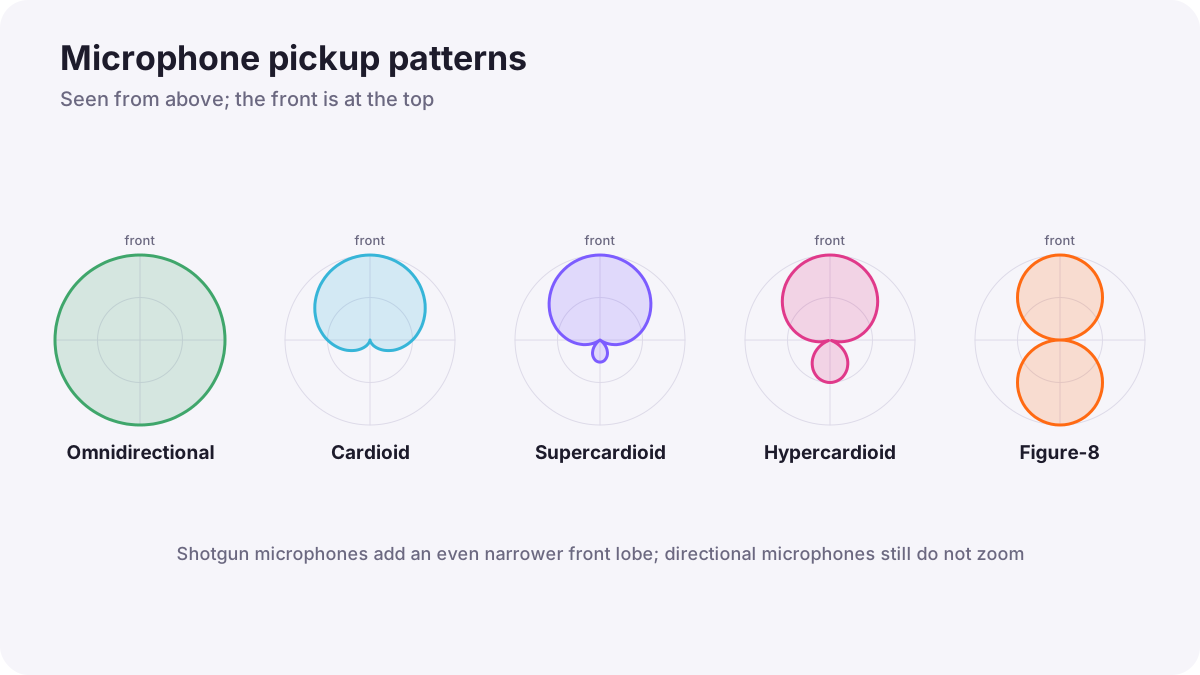
A pickup pattern, also called a polar pattern, shows how sensitive a microphone is from each direction.
| Pattern | Hears best | Ignores most | Typical use |
|---|---|---|---|
| Omnidirectional | All directions equally | Nothing | Lapel microphones, recording room atmosphere |
| Cardioid | The front, in a heart-shaped area | Directly behind | Handheld and desk microphones |
| Supercardioid / hypercardioid | A narrower area in front | The sides; a little sound from behind | Indoor boom microphones, on-camera mics |
| Shotgun (lobar) | A narrow area straight ahead | The sides | Boom microphones outdoors and at a distance |
| Figure-8 | Front and back equally | The sides | Two-person recordings, special techniques |
Tip:Directional microphones help reduce noise from the sides, but they do not zoom. A shotgun microphone 3 meters away still sounds distant. Getting close always matters most.
Microphone styles for video
| Style | Strength | Limit |
|---|---|---|
| Built-in camera microphone | Always available | Far from the subject; records camera noise |
| On-camera microphone | Better than built-in; easy | Still at camera distance |
| Lavalier (lapel) microphone | Very close to the voice | Can rustle; must be hidden or neat, as in lavalier and wireless microphones |
| Shotgun on a boom | Natural film sound, close but out of frame | Needs an operator, as in shotgun and boom microphones |
| Handheld microphone | Strong and simple for presenters | Visible in the shot |
| USB or desk microphone | Easy for voiceover and online calls | Tied to a computer |
Connections
- 3.5 mm jack: small connector common on cameras and small microphones.
- XLR: a professional three-pin connector with a locking design and less interference over long cables.
- Wireless: transmitters and receivers instead of cables.
- USB and phone connectors: for computers and phones.
Choosing a microphone
| Situation | Good choice |
|---|---|
| Vlog or walking to camera | On-camera microphone or small wireless lapel |
| Seated interview | Lapel microphone, plus a boom if possible |
| Film scene with actors | Shotgun or supercardioid on a boom |
| Voiceover at home | Cardioid condenser or dynamic in a soft room |
| Loud event or speech | Dynamic handheld or lapel, plus a feed from the sound system |
Common mistakes
- Expecting a shotgun microphone to work from far away: it still sounds distant.
- Using a sensitive condenser in a noisy, echoing room: it records the room.
- Forgetting phantom power or batteries: no sound is recorded.
- Pointing the microphone at the wrong place: voices sound thin and off-axis.
- Long unbalanced cables: hum and interference.
How sound recordists choose microphones
Sound recordists usually combine microphones: a boom with a shotgun or supercardioid for natural sound, and hidden lapel microphones as a second source. They choose patterns for the room, such as supercardioids indoors where shotguns can sound hollow, use XLR connections, and always monitor on headphones.
Practical examples
A vlogger in a busy street
- Situation
- Your camera's built-in microphone records mostly traffic.
- What to do
- You switch to a small wireless lapel microphone.
- Why it works
- A microphone close to the mouth makes the voice much louder than the street.
- Result
- A clear voice with a little natural background.
An echoey indoor scene
- Situation
- A shotgun microphone indoors makes voices sound hollow.
- What to do
- You change to a supercardioid on the boom and add blankets out of frame.
- Why it works
- Supercardioids often suit indoor rooms better, and blankets reduce reflections.
- Result
- Warmer, more natural dialogue.
Key points
- Dynamic microphones are tough and less sensitive; condensers capture more detail and need power.
- Pickup patterns decide which directions a microphone hears: omni, cardioid, supercardioid, shotgun, figure-8.
- Directional microphones reduce side noise but do not zoom; distance matters most.
- Common video mics: on-camera, lapel, shotgun on a boom, handheld and USB.
- Choose the microphone for the situation, and use XLR, batteries or phantom power correctly.
Frequently asked questions
What is the best microphone for video?
What is the difference between dynamic and condenser microphones?
What is a cardioid microphone?
What is phantom power?
Conclusion
Microphones differ in design and pickup pattern, just as lenses differ in focal length. Choose the right type for each situation, place it close, and connect and power it correctly. Next, you will learn how to use lavalier and wireless microphones.
Finished reading? Track your progress through Sound for video.