Real locations are noisy. Fridges hum, air conditioning whooshes, traffic rumbles, neighbors talk, and empty rooms echo. A sound recordist's job on location is to record dialogue that is clear enough to understand and clean enough to edit, despite all of this. Most of the work is prevention: choosing and preparing the space, controlling noise and placing microphones well. This lesson explains how to listen to a location, reduce noise and echo, place microphones, work with the rest of the crew, and what to do when a line cannot be saved.
What clean dialogue means
Clean dialogue means voices that are clear, close-sounding and consistent, with low, steady background sound and little echo. Microphones and settings were explained in microphone types and pickup patterns and recording settings. This lesson is about the location itself.
Listen when scouting
- Stand in silence for a minute and list every sound you hear.
- Check at the time you will film: traffic, schools and markets change during the day.
- Look for hard surfaces: glass, tiles and bare walls create echo.
- Ask about building noise: lifts, ventilation, construction, bells and deliveries.
- Plan a quieter backup room.
Location scouting was explained in planning a video production.
Controlling noise
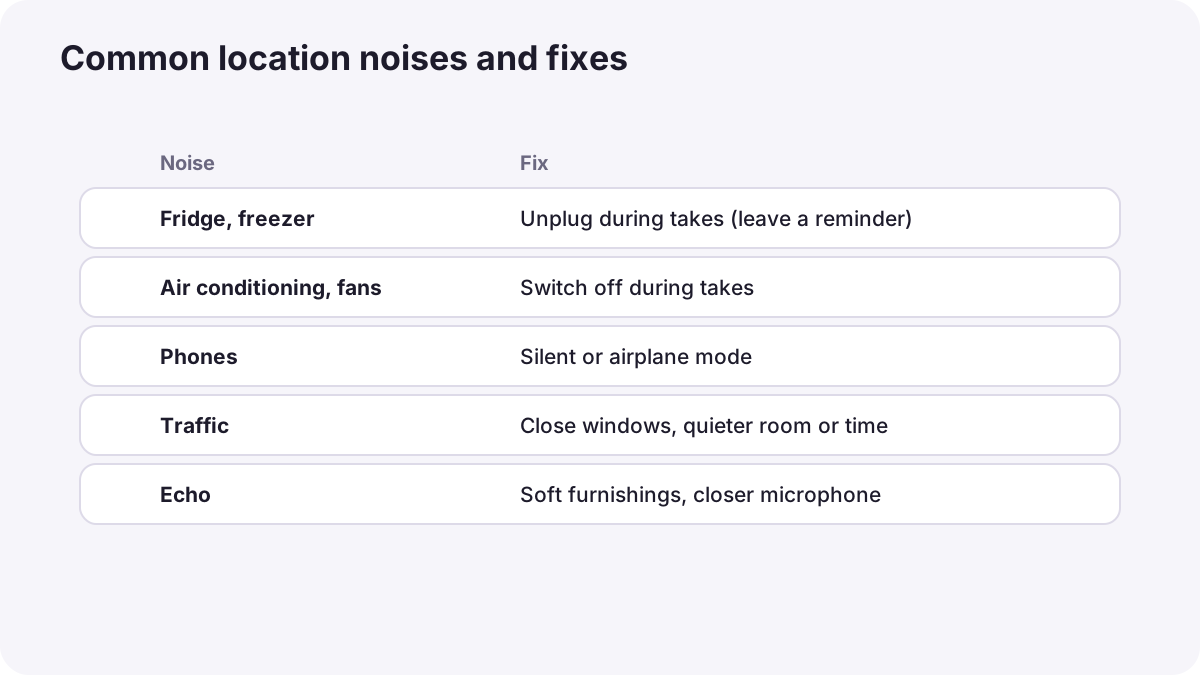
| Noise | Solution |
|---|---|
| Fridges, freezers | Unplug during takes, with a reminder note to plug back in |
| Air conditioning and fans | Turn off during takes |
| Phones and notifications | Switch to silent or airplane mode |
| Clocks and buzzing lights | Remove or switch off |
| Traffic and outdoor noise | Close windows, choose a room away from the road, film at quieter times |
| Footsteps and clothing | Soft shoes, quiet fabrics, carpet or rugs |
| Crew noise | Everyone stays still and silent during takes |
Tip:Leave a note on the steering wheel or your camera bag saying 'fridge unplugged'. Forgetting to plug a client's fridge back in is a classic mistake.
Reducing echo
- Choose furnished rooms: sofas, curtains, carpets and bookshelves absorb sound.
- Add soft materials out of shot: blankets, moving pads or cushions near the speaker and on hard floors.
- Avoid the middle of empty rooms and corners, where reflections build up.
- Get the microphone closer: the closer it is, the less room it hears, as in how sound works.
Microphone placement on location
- Use the closest practical microphone: a lav for interviews, a boom for scenes, as in lavalier and wireless microphones and shotgun and boom microphones.
- Point directional microphones away from noise: the back of the microphone toward the road or machine.
- Use two microphones when possible: a boom and a lav give the editor choices.
- Keep the distance steady so the sound matches between shots.
Working with the crew
- Call for quiet before each take and announce 'rolling'.
- Speak up when noise ruins a line: a plane or a dog barking may mean repeating the take.
- Work with lighting: some lights have noisy fans, and boom shadows must be avoided.
- Ask the director for wild lines: lines repeated without picture when a noise spoiled a good take.
When a line cannot be saved
Sometimes dialogue is unusable because of noise you could not control. Options include recording the lines again on location as wild lines, using a different take, cleaning with audio tools as in common audio problems and fixes, or ADR (automated dialogue replacement), where performers re-record lines in a studio while watching the scene. ADR is expensive and takes skill to sound natural, so it is a last resort.
Common mistakes
- Not listening when scouting: noise problems appear on the shoot day.
- Leaving air conditioning on: a constant hiss under every word.
- Filming in empty, echoing rooms: voices sound distant.
- Not calling for quiet: crew whispers and footsteps ruin takes.
- Ignoring noise during a good take: the best performance cannot be used.
How production sound teams work
Production sound teams scout with their ears, ask for noisy machines to be switched off, add sound blankets out of shot, place booms and lavs carefully, call for quiet and roll on every take, record wild lines when needed, and keep notes so editors know which takes are clean. They speak up early, because fixing sound later costs far more.
Practical examples
A kitchen interview
- Situation
- A fridge hum and hard tiles make an interview sound noisy and echoey.
- What to do
- You unplug the fridge with a reminder note, lay blankets on the floor and move the lav closer.
- Why it works
- Removing noise sources and reflections gives cleaner dialogue.
- Result
- A clear, warm-sounding interview.
A plane overhead
- Situation
- A plane passes during the actor's best line.
- What to do
- You ask for one more take and record the line again as a wild line.
- Why it works
- Noise covered the dialogue; a clean version is needed for editing.
- Result
- The editor can use the best performance with clean sound.
Key points
- Clean dialogue is clear, close and consistent, with low, steady background sound.
- Listen carefully when scouting, at the time you will film.
- Switch off fridges, air conditioning and phones, and keep crew silent during takes.
- Reduce echo with furnished rooms, soft materials and close microphones.
- Record wild lines when noise spoils a take; ADR is a costly last resort.
Frequently asked questions
How do I reduce echo when recording video?
How do I reduce background noise on location?
What are wild lines?
What is ADR?
Conclusion
Clean location dialogue comes from listening when scouting, removing noise sources, reducing echo, placing microphones close and working with the crew. Next, you will learn how room tone, ambience and wild sound make edited scenes sound complete.
Finished reading? Track your progress through Sound for video.