To record good sound, it helps to understand what sound actually is. Sound is a wave of tiny pressure changes moving through the air, and its behavior explains almost every recording problem: why voices sound distant, why rooms echo, why a microphone a little closer sounds much better, and why a recording that goes too loud is ruined. This lesson explains sound waves, frequency and pitch, loudness and decibels, how distance changes level, the digital level scale used by cameras and recorders, and how rooms reflect sound.
What sound is
Sound is a vibration that travels through air, water or solid materials as a wave of tiny pressure changes. When a person speaks, their vocal cords vibrate and push the air in waves. A microphone works like an ear: a thin part inside it moves with these waves and turns them into an electrical signal that can be recorded. Why sound matters was explained in why sound matters in video.
Frequency and pitch
Frequency is how many times the wave vibrates each second, measured in hertz (Hz). We hear high frequencies as high-pitched sounds and low frequencies as low-pitched sounds. Healthy young ears hear roughly from 20 Hz to 20,000 Hz (20 kHz); this range becomes smaller with age.
| Range | Approximate frequencies | Examples |
|---|---|---|
| Low (bass) | 20 to 250 Hz | Traffic rumble, wind noise, air conditioning, deep voices |
| Middle | 250 Hz to 4 kHz | Most of the human voice and speech clarity |
| High (treble) | 4 to 20 kHz | The 's' sounds in speech, birds, cymbals, hiss |
Tip:Many noise problems live in the low frequencies, such as wind and traffic rumble. This is why many microphones and recorders have a low-cut (high-pass) filter to reduce them.
Loudness and decibels
Loudness depends on the size of the pressure changes. It is measured in decibels (dB), a scale that works in steps rather than straight numbers, because our ears handle an enormous range of loudness. Roughly speaking, a 10 dB increase sounds about twice as loud to our ears.
| Sound | Approximate level |
|---|---|
| Quiet room at night | About 30 dB |
| Normal conversation | About 60 dB |
| Busy traffic | About 80 dB |
| Loud concert | About 100 to 110 dB |
Warning:Long exposure to very loud sound damages hearing. Protect your ears at concerts and keep headphone volume at a comfortable level.
Distance changes everything
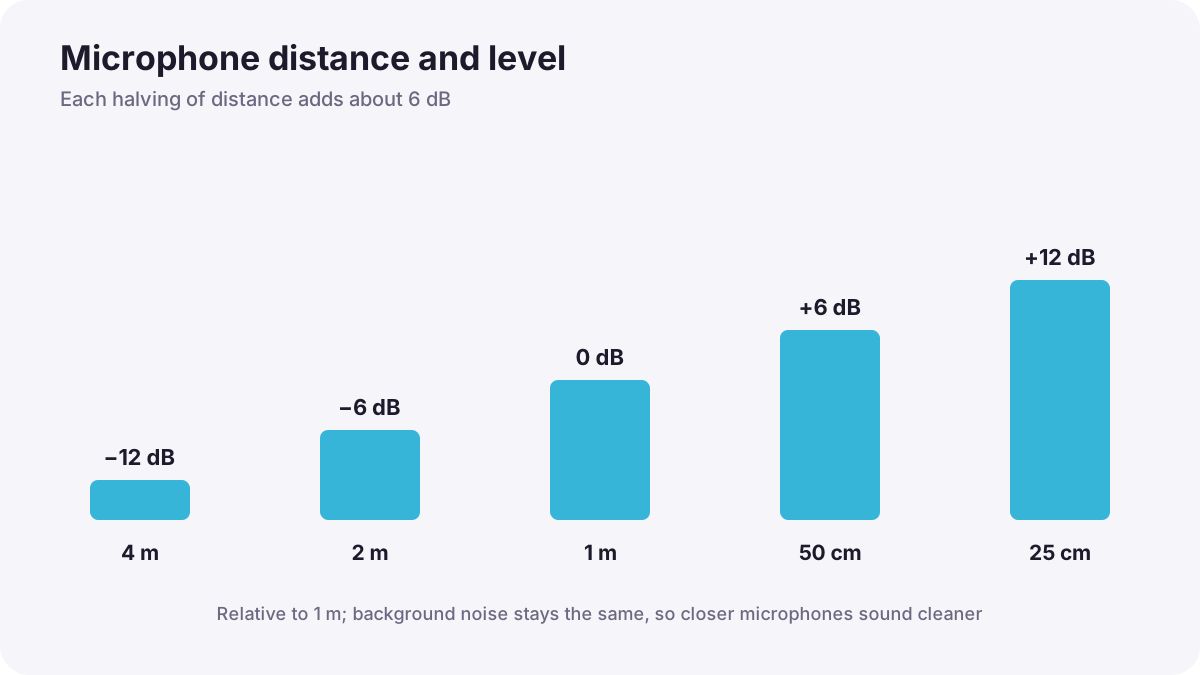
Sound spreads out as it travels, so it becomes weaker quickly with distance. In open space, every time you halve the distance between the speaker and the microphone, the level rises by about 6 dB. This is the same inverse square law that controls light, explained in understanding light.
Tip:Moving a microphone from 2 meters to 50 centimeters makes the voice about 12 dB louder, while background noise stays the same. The voice becomes much clearer compared with the noise. Close microphones are the single most important rule of good dialogue recording.
Digital levels: dBFS and clipping
Cameras and recorders show levels on a digital scale called dBFS (decibels relative to full scale). On this scale, 0 dBFS is the maximum level the recording can hold, and all normal levels are negative numbers, such as −12 dBFS.
- Clipping: if the sound goes above 0 dBFS, the tops of the waves are cut off, causing harsh distortion that usually cannot be repaired.
- Too quiet: very low levels must be boosted later, which also boosts hiss.
- A common target for dialogue: peaks around −12 to −6 dBFS, leaving room for sudden loud moments.
Setting levels in practice is explained in recording settings: levels, gain and sample rate.
Reflections and room sound
Sound bounces off hard surfaces such as walls, floors, glass and tables. In a hard, empty room, these reflections arrive at the microphone slightly after the direct voice, making it sound echoey and far away. Soft materials such as curtains, sofas, carpets, books and blankets absorb reflections. Recording in good rooms is explained in recording clean dialogue on location.
Common mistakes
- Placing the microphone far away: the voice is weak and the room is loud.
- Recording near 0 dBFS: sudden laughs or shouts clip and distort.
- Recording too quietly: hiss becomes obvious when you raise the level.
- Choosing empty, hard rooms: strong echo.
- Ignoring low rumble: traffic and air conditioning muddy the voice.
How sound recordists think
Sound recordists think about distance, direction and reflections first: they get microphones as close as possible, aim them away from noise, choose or treat rooms to reduce echo, and set levels with plenty of headroom below 0 dBFS. They listen on good headphones constantly and use low-cut filters thoughtfully.
Practical examples
A distant interview
- Situation
- An interview recorded with a microphone 2 meters away sounds weak and echoey.
- What to do
- You move the microphone to about 50 centimeters from the speaker.
- Why it works
- Halving the distance twice raises the voice about 12 dB while the room stays the same.
- Result
- A clearer, closer-sounding voice.
A distorted laugh
- Situation
- A guest's laugh distorts on the recording.
- What to do
- You lower the level so normal speech peaks around −12 dBFS.
- Why it works
- Headroom leaves space for sudden loud sounds below 0 dBFS.
- Result
- Clean speech and clean laughter.
Key points
- Sound is a wave of pressure changes; microphones turn it into an electrical signal.
- Frequency (Hz) is pitch; human hearing covers roughly 20 Hz to 20 kHz.
- Loudness is measured in decibels; a 10 dB rise sounds about twice as loud.
- Halving the microphone distance raises the level about 6 dB, so close microphones give clearer voices.
- On digital meters 0 dBFS is the limit; keep dialogue peaks around −12 to −6 dBFS to avoid clipping.
Frequently asked questions
What is a decibel?
What does dBFS mean?
What level should dialogue be recorded at?
Why does moving the microphone closer help so much?
Conclusion
Sound is a wave: frequency gives pitch, decibels measure loudness, distance changes level dramatically, digital recordings must stay below 0 dBFS, and hard rooms reflect sound. Next, you will learn the types of microphones and how their pickup patterns decide what they hear.
Finished reading? Track your progress through Sound for video.