Everything in this course comes together when you make a complete film. A short film made with a phone teaches story, shooting, sound and editing faster than any amount of reading. This lesson walks through a phone-only short film from a small idea to sharing it, with a realistic kit list, a plan that fits a weekend, and the choices that make phone films look intentional rather than accidental.
Plan a film that suits a phone
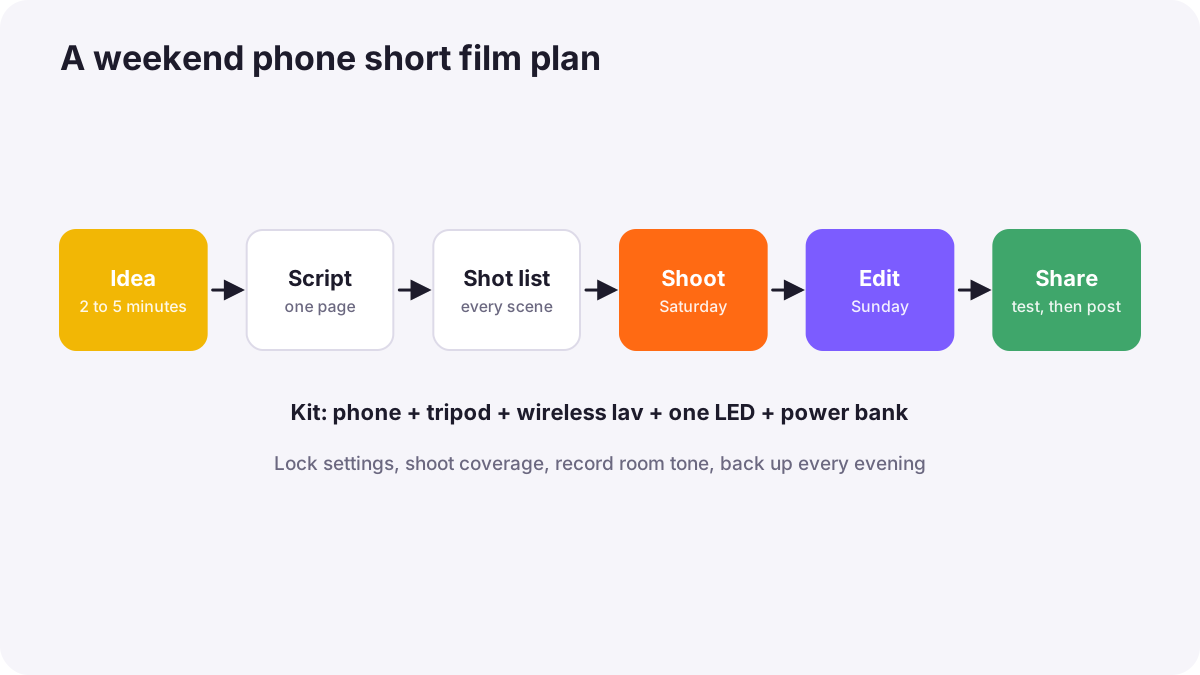
- Choose a small idea: one or two characters, one or two locations, 2 to 5 minutes long.
- Write a logline and a one-page script, as in writing a simple script.
- Use story structure: a goal, a problem and a change, as in story structure for short videos.
- Make a shot list for every scene.
- Plan locations with good light and little noise.
Tip:Choose a story where the phone's strengths help: closeness, intimacy, hidden cameras, or a character who films themself.
A realistic phone film kit
| Item | Why |
|---|---|
| Phone with plenty of storage | Hours of footage |
| Tripod and clamp | Steady shots and dialogue scenes |
| Wireless lavalier kit | Clear dialogue |
| One LED light and a reflector | Shape faces indoors |
| Power bank | A full day of shooting |
| Optional gimbal | Walking shots |
Shooting for the edit
- Lock exposure, focus and white balance for each shot, as in lesson 8.
- Use one frame rate for the whole film.
- Shoot coverage: a wide master, then closer shots and reactions, as in coverage.
- Keep cameras on one side of the line in conversations, as in continuity and the axis of action.
- Record room tone at every location.
- Back up every evening.
Finishing the film
- Edit the story first, then pace, sound and music.
- Match color between shots and give the film one consistent look.
- Add titles and credits.
- Show a test screening to a few people and improve, as in reviewing and improving your films.
- Share it: online, at screenings, or at mobile and short film festivals.
Remember:Many festivals accept films shot on phones, and some are dedicated to mobile filmmaking. Check each festival's rules before posting your film publicly, because some require premieres. The full process is in making a short film from start to finish.
Common mistakes
- A story too big for the time and kit: unfinished films.
- No external microphone: dialogue lost in noise.
- Automatic exposure in every shot: flickering, mismatched footage.
- Only wide shots: nothing to cut to.
- Never finishing: the most common mistake of all.
How professionals make phone films
Directors who shoot on phones plan carefully, add support, sound and lighting, keep settings consistent, and use the phone's size to put the camera where large cameras cannot go. They treat the phone as a real camera and the film as a real production.
Practical examples
A two-person story
- Situation
- You and a friend have one weekend and one apartment.
- What to do
- You write a three-minute story about a misunderstanding, shoot on a tripod with a wireless lav, and edit on the phone.
- Why it works
- A small idea fits the time and kit.
- Result
- A finished film you can share and learn from.
Hidden-camera feel
- Situation
- Your thriller needs an intimate, secretive look.
- What to do
- You film from low, hidden phone positions in real spaces.
- Why it works
- The phone's small size suits the story's mood.
- Result
- A tense, believable look a large camera could not easily achieve.
Key points
- Choose a small idea: few characters, few locations, 2 to 5 minutes.
- Write a logline, a one-page script and a shot list.
- A tripod, wireless lav, small light and power bank make a complete phone kit.
- Lock settings, shoot coverage, record room tone and back up daily.
- Edit story first, test screen, then share and check festival rules.
Frequently asked questions
Can you make a real film with a phone?
How long should a first phone short film be?
What do I need besides a phone?
Do festivals accept phone films?
Conclusion
A finished phone film teaches more than any plan. Next, you will learn how to turn your phone skills into a portfolio and your first paid work.
Finished reading? Track your progress through Smartphone photo and film.